
Stainless steel shaft machining costs more, takes longer, and demands more from your CNC equipment than machining the equivalent shaft in carbon steel. So when does the premium justify itself — and when are you paying for corrosion resistance that your application will never need? This guide answers that question with engineering rigour, not generalisations.
We compare stainless steel and carbon steel across the four dimensions that actually determine total-lifecycle shaft value: strength and hardness, corrosion resistance, machinability, and comprehensive cost. We provide a full material grade performance reference table, a machinability difficulty ranking, and a direct-use application decision guide — so you can arrive at the right specification before talking to your machining supplier.
This article is part of Precimach’s technical series on precision CNC turning for shafts and rotational components. View our CNC turning capabilities →
Part 1: Before Choosing a Material, Answer These Three Questions
The material selection question is never “which is better?” — it is always “which is right for this specific shaft?” Choosing stainless steel when carbon steel would do wastes budget; choosing carbon steel when the environment demands stainless guarantees premature failure. The right starting point is three functional questions:
① What type of load does the shaft carry?
Static torsion, cyclic bending fatigue, or impact loading? Carbon steel can be heat-treated to very high strength levels (4140 reaches 250–350 HB) for demanding dynamic loads. Most standard stainless grades — 304 and 316 — have significantly lower yield strength and are not suitable for high-stress power transmission shafts unless you specify precipitation-hardening grades like 17-4PH.
② What is the operating environment?
Humid air, immersion, food-contact washdown, chloride exposure, acid or alkali contact, or a dry clean indoor environment? This question alone eliminates half the candidates. A carbon steel shaft with hard chrome plating runs a hydraulic cylinder perfectly — the same shaft in a seafood processing facility will rust through the chrome within months.
③ What does the surface interface with?
Bearing inner races, mechanical seals, or open-to-product contact? A bearing interface demands high surface hardness (≥ HRC 58) and low Ra — which favours hardened carbon steel or 440C stainless. A food-contact surface demands corrosion resistance and cleanability — which favours 304 or 316. A hydraulic seal interface demands both hardness and very specific surface texture — which typically points to hardened 4140 or 4340 with hard chrome plating.
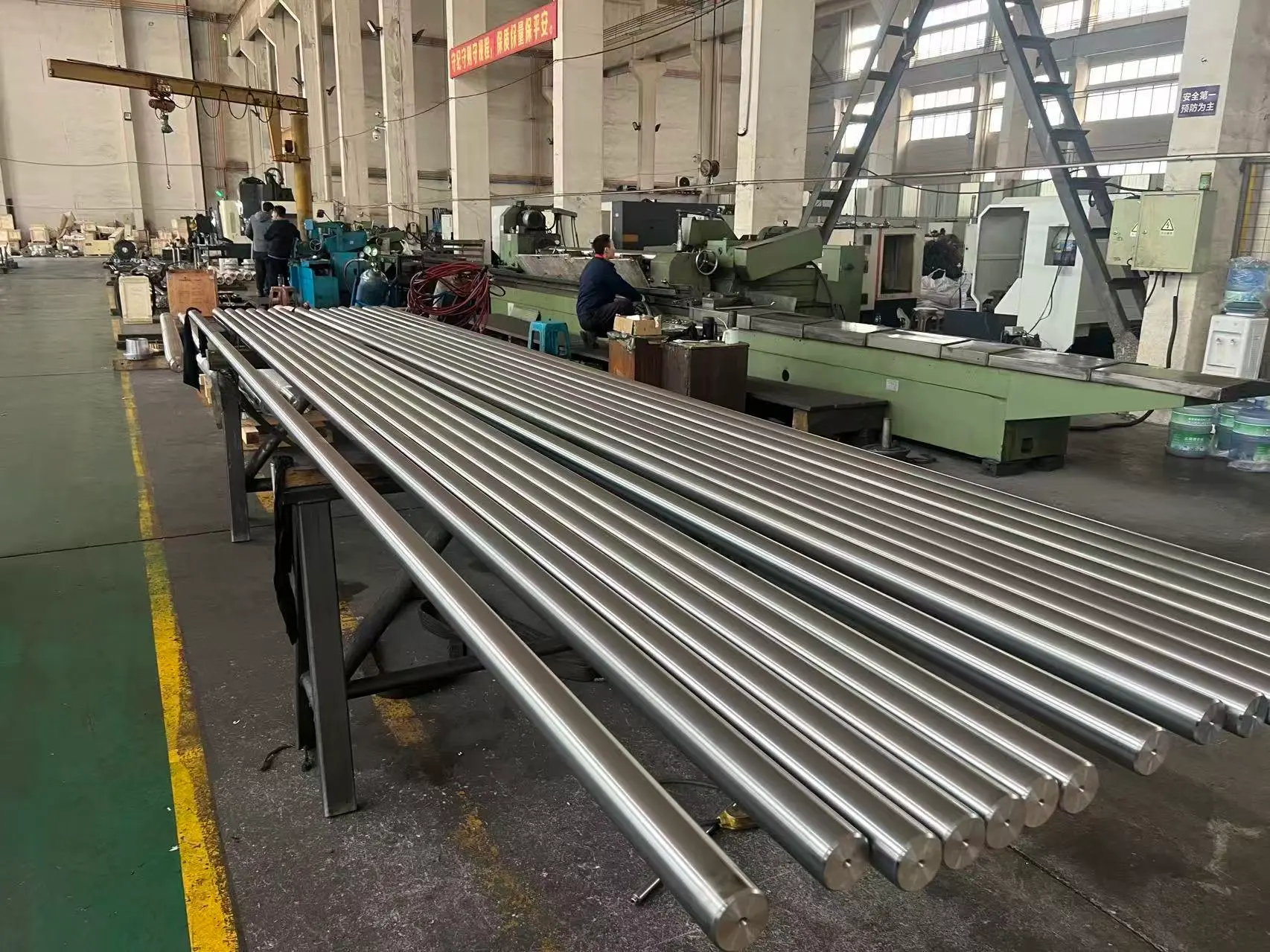
material selection determines performance across all four key dimensions
Part 2: Common Shaft Materials — Full Performance Reference Table
The following table covers the most commonly specified grades for precision shaft machining — both carbon/alloy steels and stainless steels — with key mechanical, surface, and application properties. This is the single-source reference for stainless steel shaft machining grade selection and carbon steel grade selection.
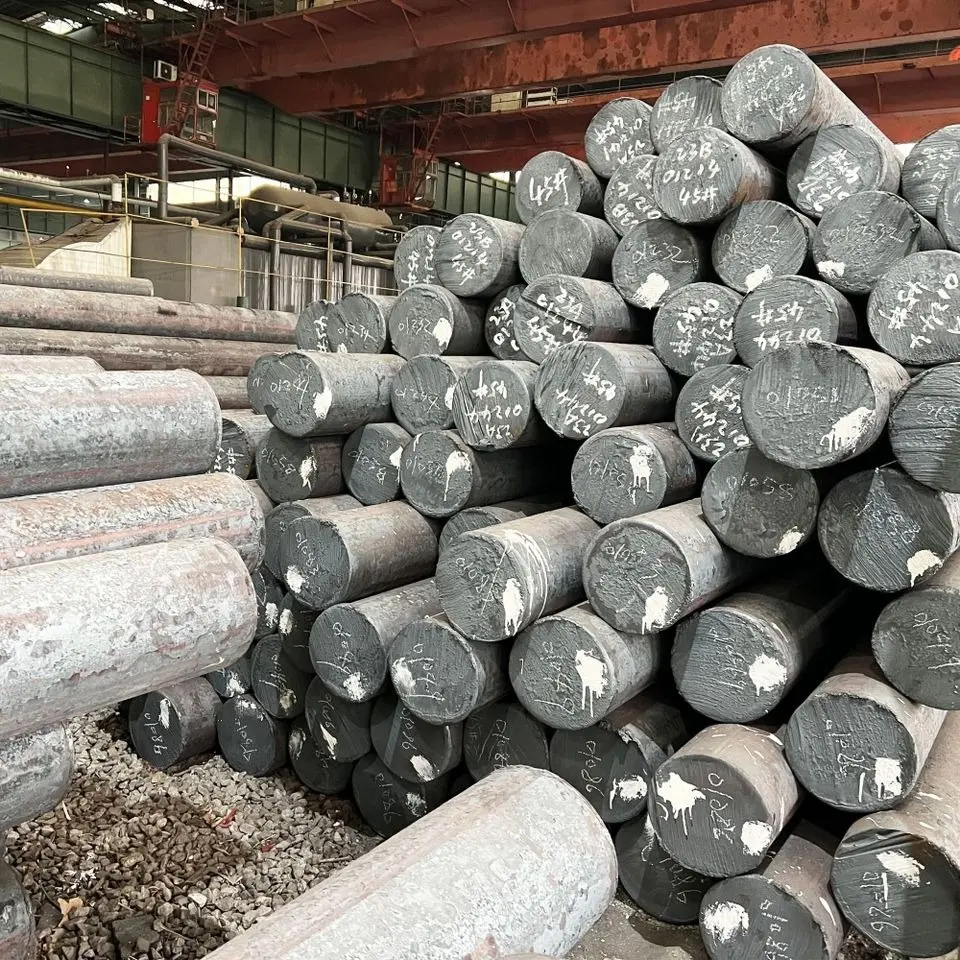
1045, 4140, 4340 shaft stock
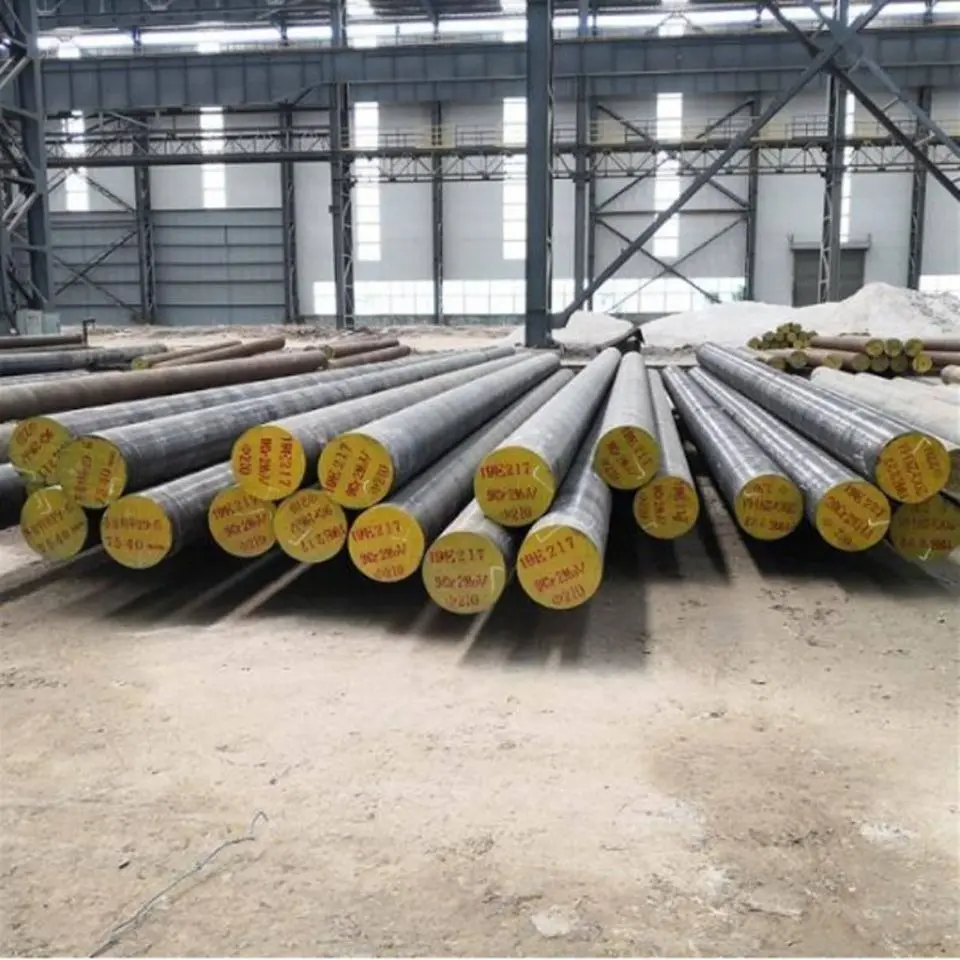
304, 316L, 2205 duplex stock
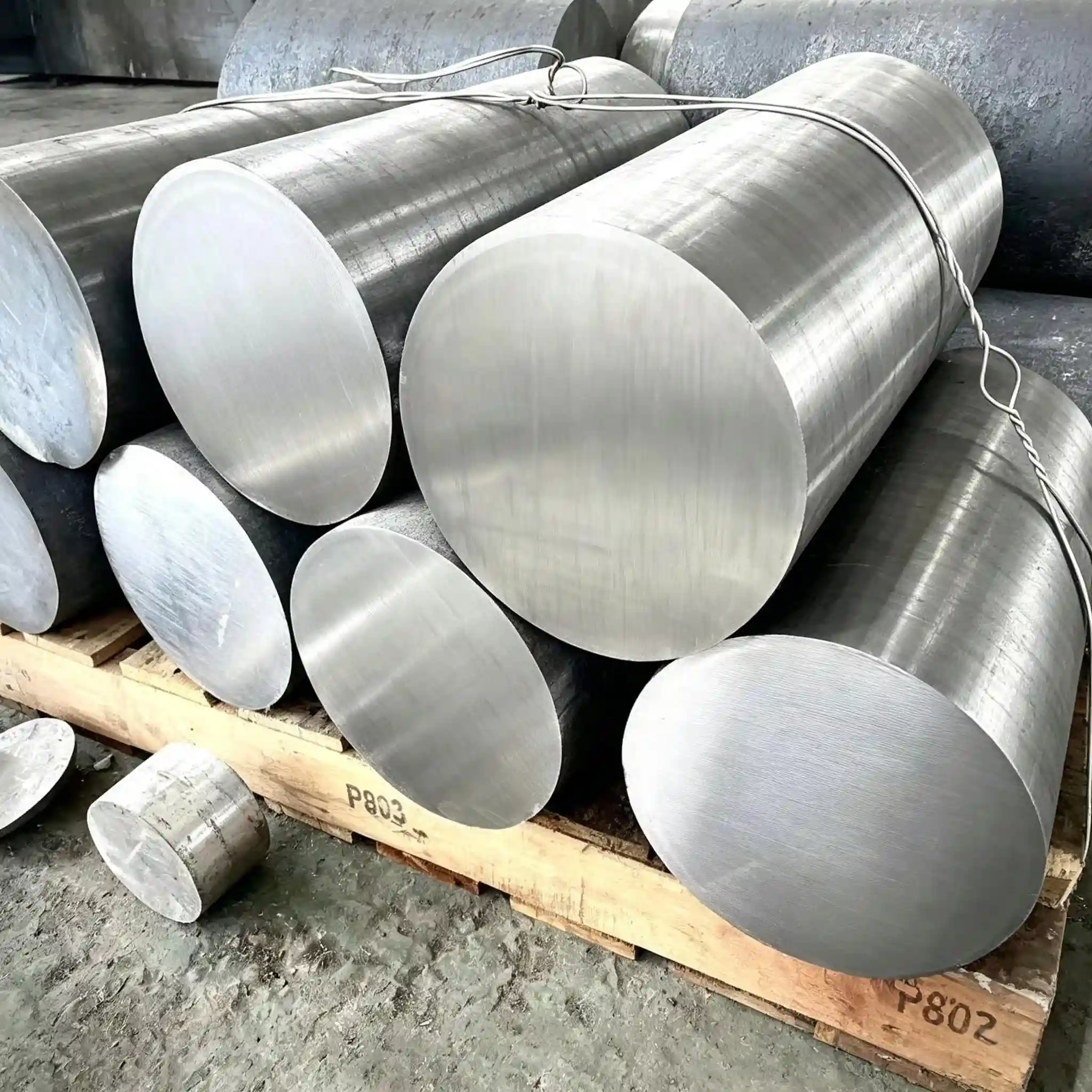
4140, 4340, 38CrMoAlA
| Grade | Type | Hardness (HRC/HB) | Yield Strength | Corrosion Resistance | Machinability | Best Application |
|---|---|---|---|---|---|---|
| CARBON & ALLOY STEELS | ||||||
| 1045 | Medium carbon | ~170–210 HB (norm.); up to HRC 55 (induction hardened) | ~530 MPa (norm.) | Poor — requires coating | Excellent | General-purpose shafts, motor shafts, machine tool spindles |
| 4140 | Cr-Mo alloy | HRC 28–34 (Q&T); up to HRC 60 (surface hardened) | 655–1,030 MPa | Poor — chrome plate for hydraulic use | Good | Hydraulic piston rods, gear shafts, high-load power transmission |
| 4340 | Ni-Cr-Mo alloy | HRC 30–54 (Q&T range) | 862–1,620 MPa | Poor | Good | Aerospace drivetrain, heavy-duty gearbox shafts, high-fatigue applications |
| 38CrMoAlA | Nitriding steel | ≥ 900 HV surface (nitrided) | 835 MPa (Q&T) | Moderate (nitrided layer) | Good | Hydraulic cylinder piston rods, precision bearing shafts (Chinese standard) |
| GCr15 (52100) | Bearing steel | HRC 60–65 (hardened) | ~1,500 MPa | Poor | Moderate | Bearing inner/outer races, precision rollers, high-wear contact shafts |
| STAINLESS STEELS | ||||||
| 304 / 304L | Austenitic | ~170 HB (annealed) — not hardenable by heat treatment | 205–310 MPa | Good — general corrosion | Moderate (work-hardens) | Food processing, general industrial, light-load corrosion-resistant shafts |
| 316 / 316L | Austenitic + Mo | ~160–190 HB (annealed) | 170–310 MPa | Excellent — chloride / marine | Moderate | Marine pumps, chemical processing, pharmaceutical, seawater immersion |
| 17-4PH | Precipitation hardening | HRC 33–40 (H1025); HRC 40–44 (H900) | 790–1,170 MPa | Good | Moderate-Hard | Aerospace, UAV, medical: needs both high strength AND corrosion resistance |
| 440C | Martensitic | HRC 58–62 (hardened) | ~1,900 MPa (hardened) | Moderate | Difficult | Stainless steel bearings, valve balls, precision contact components requiring high hardness |
| 416 | Free-machining martensitic | HRC 26–32 (Q&T) | 620–825 MPa | Moderate | Best in SS family | Complex precision stainless shaft profiles where machinability is priority |
| 2205 Duplex | Duplex | ~290 HB | 450–620 MPa | Superior — highest chloride resistance | Very Difficult | Offshore oil and gas, seawater desalination, aggressive chemical environments |
Part 3: The Four Decisive Dimensions — Quantified
① Strength and Hardness
This is the dimension where carbon and alloy steels hold the clearest advantage over most stainless grades. Heat-treated 4140 reaches 250–350 HB and tensile strengths up to 1,030 MPa. Induction-hardened 38CrMoAlA develops a surface hardness exceeding 900 HV at the critical wear surface. These are the materials of choice for shafts that transmit real power under fatigue loading.
Standard austenitic stainless steels (304/316) have yield strengths in the 205–310 MPa range and cannot be hardened by heat treatment — only by cold working, which is impractical for shaft production. Their strength makes them suitable for moderate loads in corrosive environments, not for primary power transmission.
The exception is 17-4PH precipitation-hardening stainless. In the H900 temper, 17-4PH reaches 1,170 MPa yield strength and HRC 40–44 — approaching alloy steel territory while retaining stainless-class corrosion resistance. This is why 17-4PH is specified for aerospace UAV drivetrain shafts, medical device drive components, and any application where the shaft must simultaneously handle real structural load and a corrosive environment.
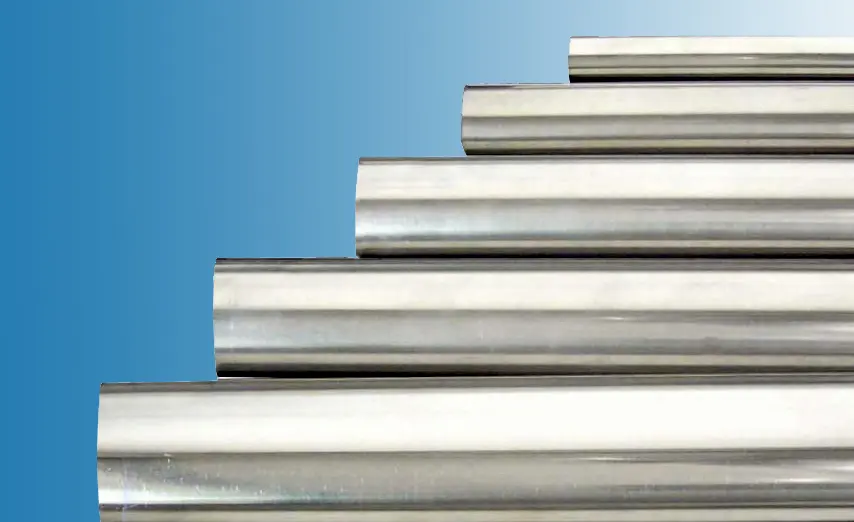
H6/H7 tolerance stock for shaft machining
② Corrosion Resistance
Corrosion resistance is stainless steel’s fundamental advantage and the defining reason for specifying it. The passive chromium oxide film that forms on stainless steel surfaces regenerates automatically when scratched — providing self-healing protection that no applied coating can replicate.
Carbon steel in humid environments
Iron oxidises to form loose, porous iron oxide (rust) that does not protect the underlying metal — it accelerates corrosion by absorbing more moisture. A carbon steel shaft will begin to corrode in moist air within days without a protective coating. When that coating is scratched, the exposed steel corrodes at the scratch location and undercutting proceeds laterally beneath the intact coating.
Stainless steel in the same environment
The chromium oxide passive layer (minimum 10.5% Cr content required) is dense, adherent, and self-regenerating. If scratched, the passive layer reforms in the presence of oxygen. 316 with its molybdenum content provides additional resistance to chloride pitting and crevice corrosion — the specific failure mode in marine and food-processing chloride environments where 304 is sometimes insufficient.
The practical implication for shaft machining: In a food-processing facility, a carbon steel shaft with hard chrome plating will last — until the first time a seal leaks hydraulic cleaner against the rod, or the coating develops a micro-crack from bending load, and corrosion undercuts the chrome from beneath. A 316L stainless shaft does not have this failure pathway. The premium is not for the corrosion resistance itself — it is for the elimination of this entire failure mode from your maintenance schedule.
③ Machinability — The Dimension Most Buyers Underestimate
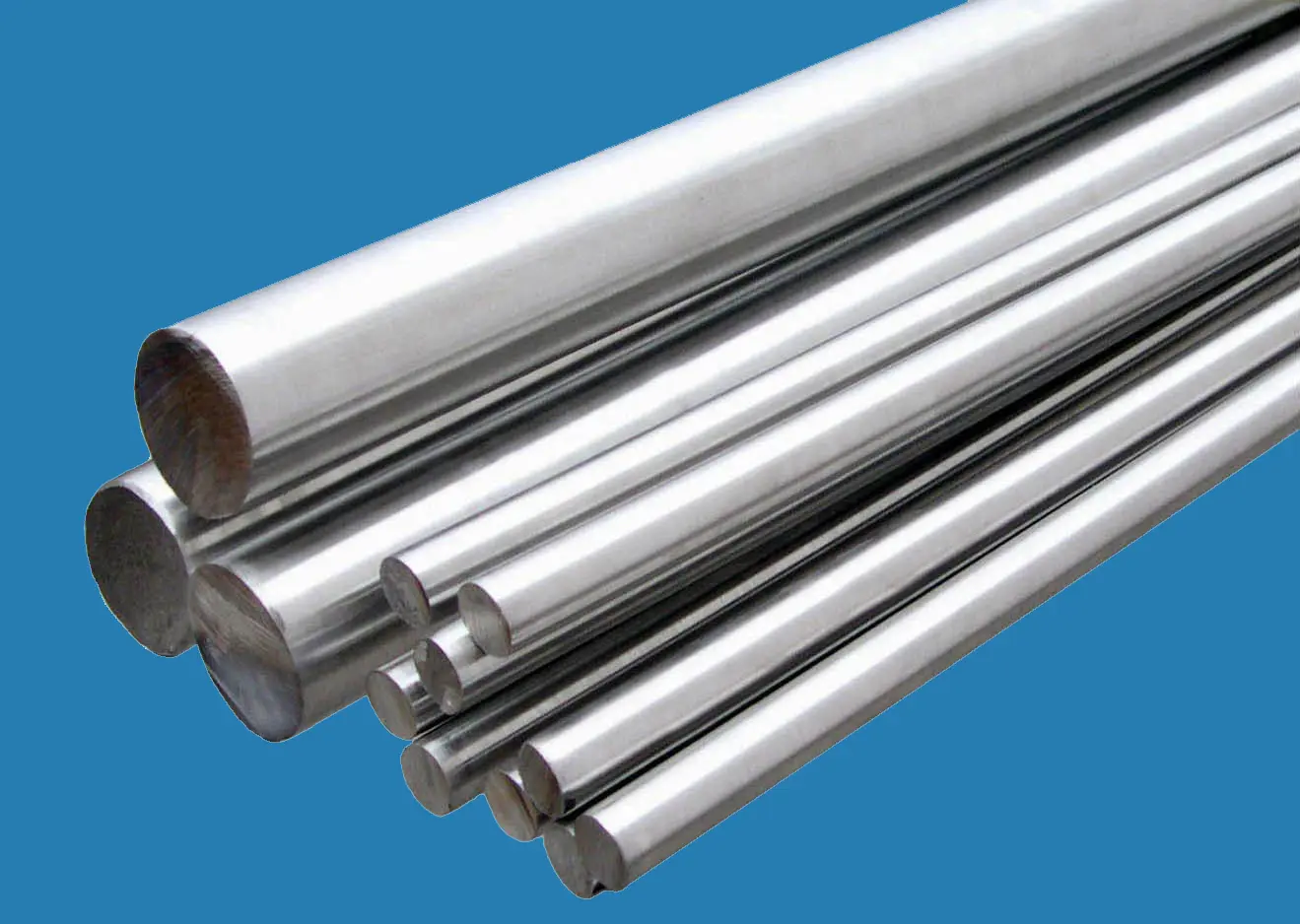
excellent machinability for high-volume shaft turning
Machinability determines both the cost of producing the shaft and the process risk. The standard machinability index (AISI 1212 = 100%) tells the story clearly:
- 1045 carbon steel: ~65% — good general machinability
- 4140 alloy steel (annealed): ~65% — similar to 1045
- 12L14 free-machining carbon steel: ~160% — fastest-cutting shaft material
- 304 stainless steel: ~45% — significant work-hardening, requires sharp tooling and rigid setup
- 316 stainless steel: ~35–40% — worse than 304 due to higher Mo content
- 17-4PH (aged): ~25–35% — high cutting forces, challenging for slender shaft work
- 416 free-machining stainless: ~85% — best machinability in the stainless family
- 2205 duplex: ~20% — very difficult; high tool wear, poor chip breaking
Practical cost implication: A 316 stainless shaft that takes 3× as long to turn as the equivalent 4140 shaft, uses 2× as many inserts, and requires more frequent resharpening will cost 2–3× more to machine — before accounting for the material price premium. For slender shafts (L/D > 8:1), the difficulty compounds: stainless steel’s work-hardening tendency and poor chip breaking increase vibration risk, making the steady rest and cutting parameter management even more critical.
Stainless steel shaft machining difficulty ranking (easiest to hardest):
| Difficulty | Grade | Notes for Shaft Machining |
|---|---|---|
| Easiest | 416, 303 | Sulphur-added free-machining grades. Good chip breaking. Suitable for complex precision shaft profiles on multi-axis CNC. |
| Moderate | 304, 316, 440C (annealed) | Work-hardening is the main challenge. Large depth of cut, sharp PVD-coated carbide inserts, rigid setup, and consistent coolant are essential. Do NOT allow rubbing — tool must always be cutting. |
| Moderate-Hard | 17-4PH (solution treated) | Machine in solution-treated (annealed) condition, then age harden after rough machining. Final grinding after ageing for tight tolerances. |
| Hard | 17-4PH (aged), 440C (hardened) | High cutting forces. For slender shafts, deformation risk is significant. Follower rest support mandatory for L/D > 6:1. |
| Hardest | 2205 Duplex | Very high cutting forces, poor chip control, rapid tool wear. Requires specialist process engineering. Not suitable for slender shaft work on standard equipment. |
④ Comprehensive Cost — Acquisition vs Lifecycle
The correct cost comparison is never purchase price — it is total lifecycle cost including maintenance interventions, replacement frequency, and downtime impact. The answer reverses depending on the application:
Carbon steel wins on: acquisition cost
Raw material at 20–40% of stainless price, machining at 2–3× the speed, lower insert consumption. For indoor applications with mild environments, the lifecycle cost calculation confirms the acquisition advantage — maintenance is minimal and service intervals are long.
Stainless wins on: corrosive environment lifecycle
In marine, food-processing, or chemical environments, carbon steel shafts require frequent replacement or re-coating, generate downtime, and may contaminate product. A stainless shaft at 3× the purchase price that lasts 10× as long in this environment has a lifecycle cost advantage of approximately 3:1 in favour of stainless.
The hidden cost: coating failure
Carbon steel shafts with hard chrome or other protective coatings carry a latent cost: when the coating fails (and in aggressive environments, it will), the failure is often accelerated by galvanic corrosion at the coating breach. This failure mode does not exist for stainless shafts. Factor the coating maintenance programme into any carbon-vs-stainless lifecycle comparison in wet or chemical environments.
Part 4: Application Decision Guide — Which Material for Which Shaft?
The following decision table translates the four-dimension analysis into direct application guidance. Each row represents a real application type that Precimach machines regularly.
| Application | Recommended Material | Reason |
|---|---|---|
| Hydraulic cylinder piston rod | Induction-hardened 4140 + hard chrome | Maximum fatigue life and surface hardness. Chrome provides corrosion and wear protection for the seal interface. |
| Food processing / beverage shaft | 304 or 316L stainless | No coating to delaminate into product. Withstands CIP/SIP wash-down. Regulatory compliance for food contact. |
| Gearbox/power transmission shaft | 4140 or 4340, Q&T | High fatigue strength under cyclic torsional load. Heat treatment flexibility to match load profile. Cost-effective. |
| Aerospace/UAV drivetrain shaft | 17-4PH (H900/H1025) | Only grade combining structural strength ≥ alloy steel with corrosion resistance and light weight for aerospace packaging. |
| Marine / offshore pump shaft | 316L or 2205 duplex | 316L for moderate chloride; 2205 for severe seawater immersion / high-velocity seawater. Mo and N content resists pitting. |
| General indoor machine shaft (dry) | 1045 or 4140 carbon steel | Lowest acquisition and machining cost. Simple oil film or paint sufficient for dry indoor environment. No corrosion risk to manage. |
| Medical device shaft | 316L or 17-4PH | 316L for biocompatibility and sterilisation resistance. 17-4PH where load demands higher strength. Both ISO 10993 compliant. |
| Mixing shaft (chemical / pharmaceutical) | 316L stainless | Direct product contact in aggressive media. 316L provides Mo-enhanced resistance to chloride and organic acid attack. |
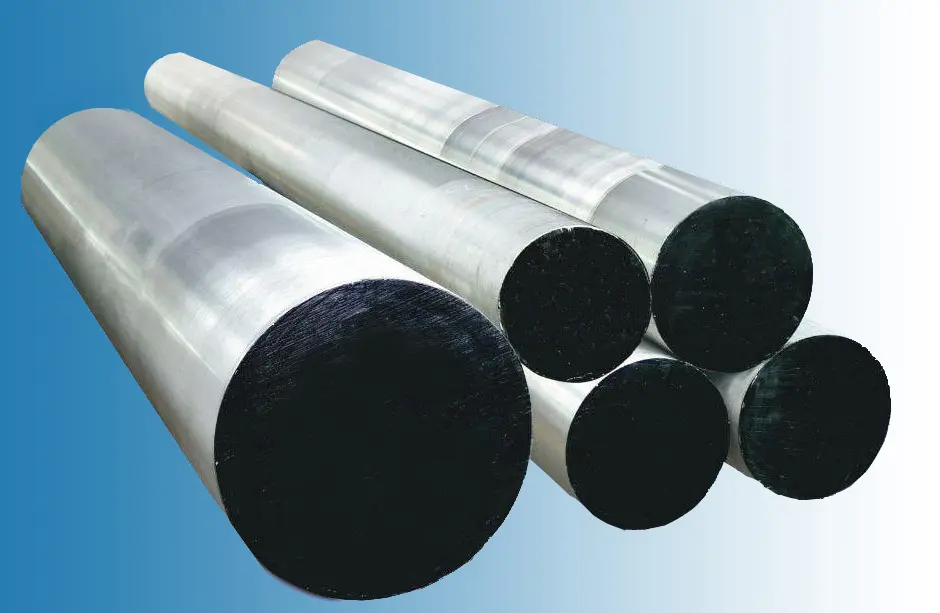
4140, 4340: the workhorses of high-load shaft production
Part 5: Practical Notes on Stainless Steel Shaft Machining
For engineers specifying stainless steel shaft machining on a procurement drawing, there are several practical points that will directly affect the quotation you receive and the quality outcome:
1
Specify the grade — not just “stainless steel”
A drawing that says only “stainless steel” will either receive a clarification request or a quotation based on the cheapest grade available. 304, 316L, 17-4PH, 440C, and 416 have machining costs that differ by 3–5×. Specifying the grade is not over-specifying — it is protecting the integrity of your quotation comparison.
2
For 17-4PH: specify the heat treatment condition and sequence
Machine 17-4PH in the solution-treated (Condition A) state, then age harden. Attempting to machine in the H900 condition adds 30–50% machining cost and increases tool wear dramatically. The drawing should specify: “Machine in Condition A, age harden to H1025 after rough machining, precision grind to final dimensions after ageing.”
3
Stainless slender shafts require the same steady rest discipline as carbon steel
The work-hardening tendency of 304/316 compounds the deflection problem on slender shafts. If the tool dwells on a work-hardened spot, it generates more cutting force, more deflection, and more work-hardening in a destructive cycle. Follower rest support for L/D > 6:1 is non-negotiable for stainless steel shaft machining at tight tolerances.
4
Consider 416 or 303 when you need stainless and machinability
If your application is corrosion-resistant but not in a severe chloride environment — and the shaft has complex profiles, tight tolerances, or high volume — the free-machining stainless grades (416, 303) can reduce machining cost by 40–60% relative to 304 or 316, with adequate corrosion resistance for many applications. Ask your machining supplier about this option before defaulting to 316.
For further technical reference on stainless steel grades, composition requirements, and corrosion resistance testing applicable to precision machined shaft components, the ASTM A276/A276M standard (Standard Specification for Stainless Steel Bars and Shapes) is the internationally recognised specification for stainless steel round bar stock used in precision machined components — covering chemical composition, mechanical property requirements, and surface condition for all major stainless grades including 304, 316, 410, 416, 17-4PH, and 440C.
Industry reference: ASTM A276/A276M — Standard Specification for Stainless Steel Bars and Shapes is the primary US and internationally referenced standard for stainless steel round bar stock chemical composition, mechanical properties, and acceptance criteria — used by precision shaft manufacturers and procurement engineers globally to specify and verify stainless steel raw material quality for machined components.
Summary: The Decision Is Never Just Material — It Is Material + Process
The choice between stainless steel and carbon steel for a precision shaft is not a preference — it is an engineering derivation from three questions: load type, environment, and surface interface. Carbon and alloy steels win on strength, machinability, and acquisition cost for power transmission shafts in dry or protected environments. Stainless steels win on corrosion resistance and lifecycle cost in food, medical, marine, and chemical environments where coating-based protection is unreliable.
The material selection table and decision guide above give you the answer for the most common application types. When the application is unusual — or when you are trying to reduce cost on an existing design — the right supplier can review your functional requirements and propose a material-plus-process solution that meets the specification at the lowest justified cost.
Need precision CNC machined shafts in stainless steel or carbon steel?
Precimach is an ISO 9001 certified CNC machining factory in Suzhou, China — specialising in precision shaft turning across stainless steel (304, 316L, 17-4PH, 440C), alloy steels (4140, 4340, 38CrMoAlA), and engineering materials. We provide free DFM analysis and material selection review with every quote.
- Shaft turning: 20mm to 16,000mm length — with follower rest for slender shafts
- Stainless steel shaft machining: 304, 316L, 17-4PH, 440C, 416, 2205 duplex
- Carbon and alloy steel: 1045, 4140, 4340, 38CrMoAlA, GCr15
- Surface treatments: hard chrome, electroless nickel, induction hardening, nitriding
- Tolerances to ±0.005mm · Surface finish to Ra 0.1 μm with Rz/Rmr verification
- Free material substitution review — we propose the right grade for your application