
Surface Finishing Services at Precimach
 Plating Anodizing Powder coating Pad and Silk Screen Printing Sand blasting Polishing Heat treating
Standard Machined Finish Finish
A standard machined finish is the default surface condition after CNC machining. Parts will show visible machining marks, with a typical surface roughness ranging from Ra 1.6 to 3.2 μm.
This finish is suitable for functional or internal components where appearance is not critical. Since no protective coating is applied, parts may be more susceptible to minor scratches or wear during handling and use.
Anodizing
Anodizing is an electrochemical surface treatment used primarily for aluminum CNC machined parts. It creates a durable oxide layer that improves corrosion resistance, wear resistance and surface appearance.
During the anodizing process, aluminum parts are immersed in an electrolyte solution and electrically charged, forming a controlled oxide layer on the surface. This layer becomes an integral part of the material, providing long-lasting protection without peeling or flaking.
We offer both Type II anodizing for decorative and corrosion-resistant applications, and Type III hard anodizing for increased wear resistance and durability. Different coating thicknesses and color options are available based on application requirements.
Anodizing is widely used in aerospace, automotive, electronics and industrial components where surface durability and appearance are critical.
Bead Blasting
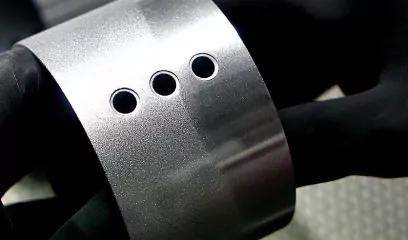
Bead blasting is a surface finishing process commonly used for CNC machined aluminum parts to create a uniform matte or satin appearance.
During the process, fine glass beads are blasted onto the part surface under controlled pressure, removing minor tool marks and improving visual consistency without significantly altering part geometry.
Bead blasting is primarily used for cosmetic purposes and is often applied before anodizing or other secondary finishes. Critical features such as threads and precision holes can be masked to protect dimensional accuracy.
This finish is ideal for parts where a clean, non-reflective and evenly textured surface is required.
Powder Coating
Powder coating is a durable surface finishing process that applies a dry powder to metal parts using electrostatic spray, followed by heat curing to form a hard, protective coating.
This finish provides excellent resistance to wear, corrosion, and impact while offering a smooth and consistent appearance. Powder coating is suitable for a wide range of metals and is commonly used for parts that require both functional protection and long-term durability.
It is an ideal choice for industrial components, enclosures, brackets, and structural parts exposed to demanding environments.
Polishing
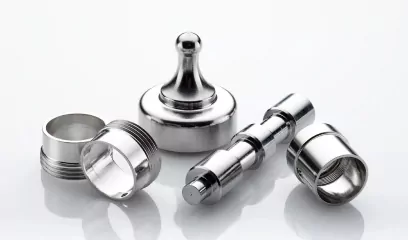
Polishing is used to achieve a smooth, clean and reflective surface finish on machined parts. It improves surface appearance while reducing roughness, minor tool marks and surface imperfections.
We provide multiple polishing processes including mechanical polishing, chemical polishing and electropolishing, depending on part geometry, material and surface requirements. Polishing is widely applied in precision machinery, optical components and high-appearance industrial parts.
Mechanical polishing is mainly used for standard metal parts and can achieve surface roughness down to Ra 0.8 μm. Chemical polishing is suitable for thin-walled parts, deep holes and complex geometries, offering uniform surface leveling with high efficiency.
Electropolishing is an electrochemical process that removes micro-peaks from metal surfaces, further improving smoothness and corrosion resistance. For stainless steel, aluminum and non-ferrous metals, surface roughness as low as Ra 0.3 μm can be achieved.
Plating
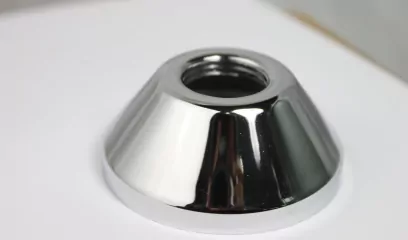
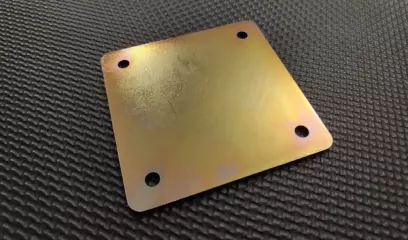
Plating is a surface finishing process that applies a thin metallic coating onto a conductive part to improve its durability, corrosion resistance, and surface properties.
Common plating options include nickel plating, chrome plating, tin plating, and silver plating, each selected based on the required performance, conductivity, and appearance.
Plating is widely used for steel and stainless steel components where improved wear resistance, corrosion protection, or electrical performance is required.