Precision shaft machining sits at the heart of reliable hydraulic and industrial equipment. Whether you are sourcing stainless steel mixing shafts for agitation and blending applications or piston rods for hydraulic cylinders and actuators, the dimensional accuracy, surface finish, and coaxiality achieved during CNC turning directly determine service life, sealing performance, and maintenance intervals.
This article shares Precimach’s manufacturing approach to stainless steel mixing shaft production and outlines the 7 essential technical requirements for precision piston rod CNC turning — practical knowledge for engineers and procurement professionals specifying these components from a CNC machining partner.
This article is part of Precimach’s technical series on CNC turning for rotational and shaft components. View our CNC turning capabilities →
Part 1: Stainless Steel Mixing Shaft Machining
What Is a Stainless Steel Mixing Shaft?
A stainless steel mixing shaft is a precision rotational component used in agitation, blending, and fluid processing equipment. It transmits rotational torque from a drive unit to an impeller, paddle, or agitator blade submerged in a process fluid. Applications span the chemical, pharmaceutical, food and beverage, wastewater treatment, and specialty materials industries — wherever reliable, corrosion-resistant shaft performance is required in continuous or intermittent wet-process environments.
Because mixing shafts are continuously immersed in process media — which may include corrosive chemicals, abrasive slurries, or food-grade liquids subject to strict hygiene standards — material selection, surface finish, and dimensional precision are all critical manufacturing considerations.
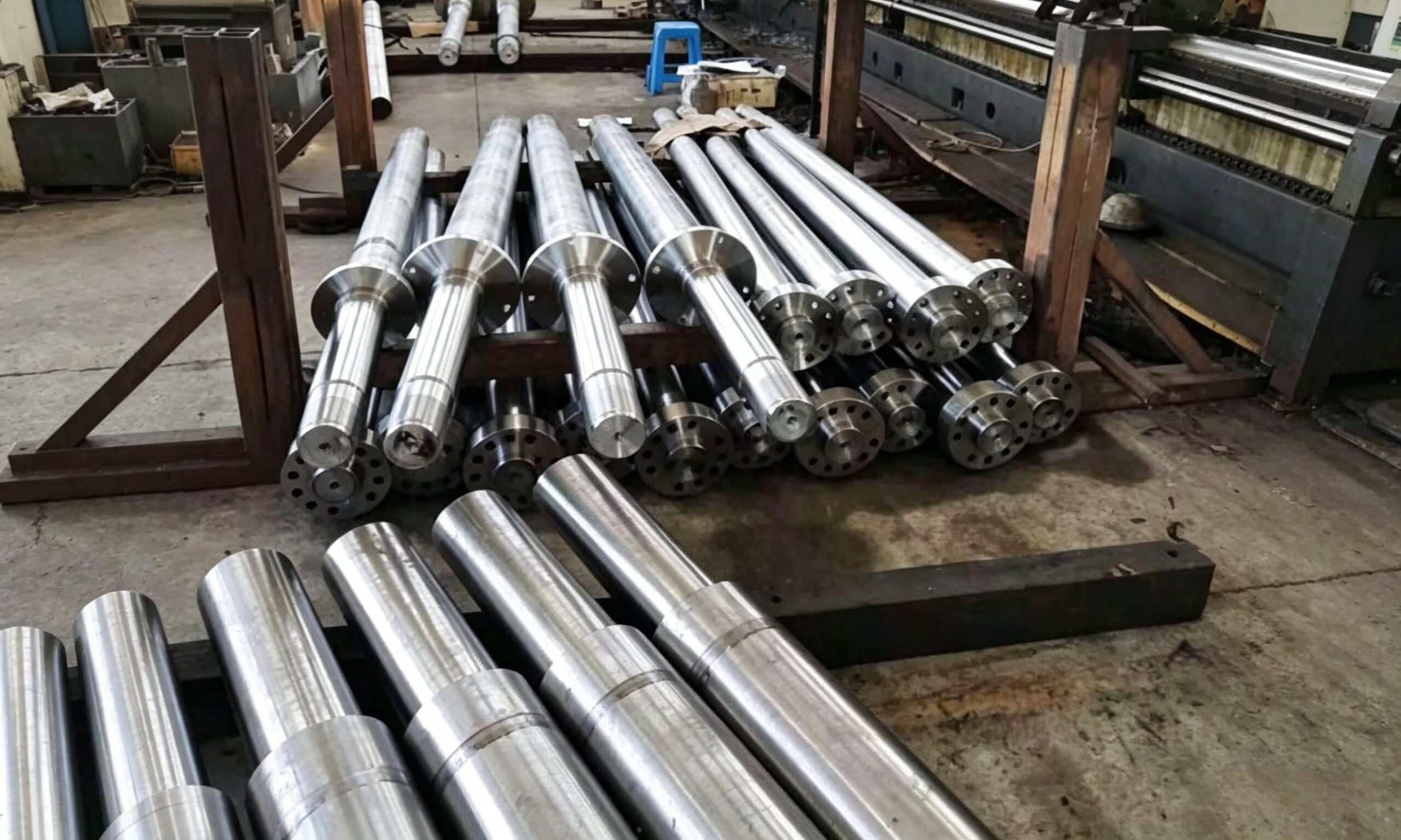
precision surface finish and strict coaxiality control
Material Selection: Why Stainless Steel?
The most commonly specified grades for mixing shaft applications are 316L and 304 stainless steel. 316L is preferred in chemical and pharmaceutical environments due to its higher molybdenum content, which provides superior resistance to chloride pitting and crevice corrosion. 304 is widely used in food processing and general industrial agitation where corrosion conditions are less severe and cost is a priority.
From a machinability standpoint, stainless steel presents several challenges compared to carbon steel or aluminum: its work-hardening tendency, low thermal conductivity, and tendency to produce built-up edge (BUE) on cutting tools all require careful process management. At Precimach, we address these challenges through appropriate tooling selection (PVD-coated carbide inserts with positive rake geometry), conservative cutting parameters, and effective coolant application to control heat at the cutting zone.
Key Machining Requirements for Mixing Shafts
Critical dimensional and surface parameters:
- Straightness: Long mixing shafts must achieve straightness tolerances within 0.05–0.1mm over the full length to prevent vibration and bearing overload during high-speed rotation. For shafts with L/D ratios exceeding 8:1, steady rest support during turning is mandatory.
- Cylindricity: The shaft bearing journal diameter must be held within the specified tolerance class (typically h6 or h7) with cylindricity error not exceeding half the diameter tolerance.
- Surface finish: Bearing journals require Ra ≤ 0.8 μm; wetted surfaces in food or pharmaceutical applications typically require Ra ≤ 0.4 μm (electropolished or mechanically polished after turning to remove micro-crevices that harbor bacteria).
- Coaxiality: All shaft diameters must be coaxial within specified limits — typically 0.02–0.05mm total indicator runout (TIR) — to prevent eccentric loading on bearings and mechanical seals.
- Thread integrity: Drive-end and impeller-end threads must be cut to full tolerance class with correct thread form and surface finish to ensure positive, leak-free assembly engagement.
CNC Turning Process for Long Stainless Steel Mixing Shafts
For long mixing shafts — where the length-to-diameter (L/D) ratio is the primary machining challenge — Precimach follows a structured turning sequence designed to minimize workpiece deflection, thermal distortion, and residual stress accumulation:
- Rough turning with steady rest support — removes the majority of stock while steady rests prevent deflection. Generous stock left for finishing (0.3–0.5mm per side).
- Stress relief — for shafts where residual machining stress could cause post-machining distortion, a natural or artificial aging step is incorporated between rough and finish turning.
- Semi-finish and finish turning — achieves final diameter to tolerance with progressive depth-of-cut reduction. Cutting speed and feed are optimised for stainless steel surface finish.
- Thread turning — both ends machined to specified thread class. Center rest supports the shaft during threading operations to maintain coaxiality.
- Final inspection — CMM measurement of all critical diameters, runout at bearing journals, straightness over full length, and surface roughness verification with profilometer.
Post-turning, customer-specified surface treatments — including mechanical polishing, electropolishing, or passivation per ASTM A967 — can be coordinated through Precimach’s supply chain, delivered as fully finished shafts ready for assembly.
Precimach capability note: We regularly produce stainless steel mixing shafts from 20mm to 200mm diameter and up to 3,000mm in length, with steady rest support for L/D ratios up to 15:1. Material certifications and full CMM reports are available for every batch. Request a quote →
Part 2: 7 Essential CNC Turning Techniques for Piston Rods
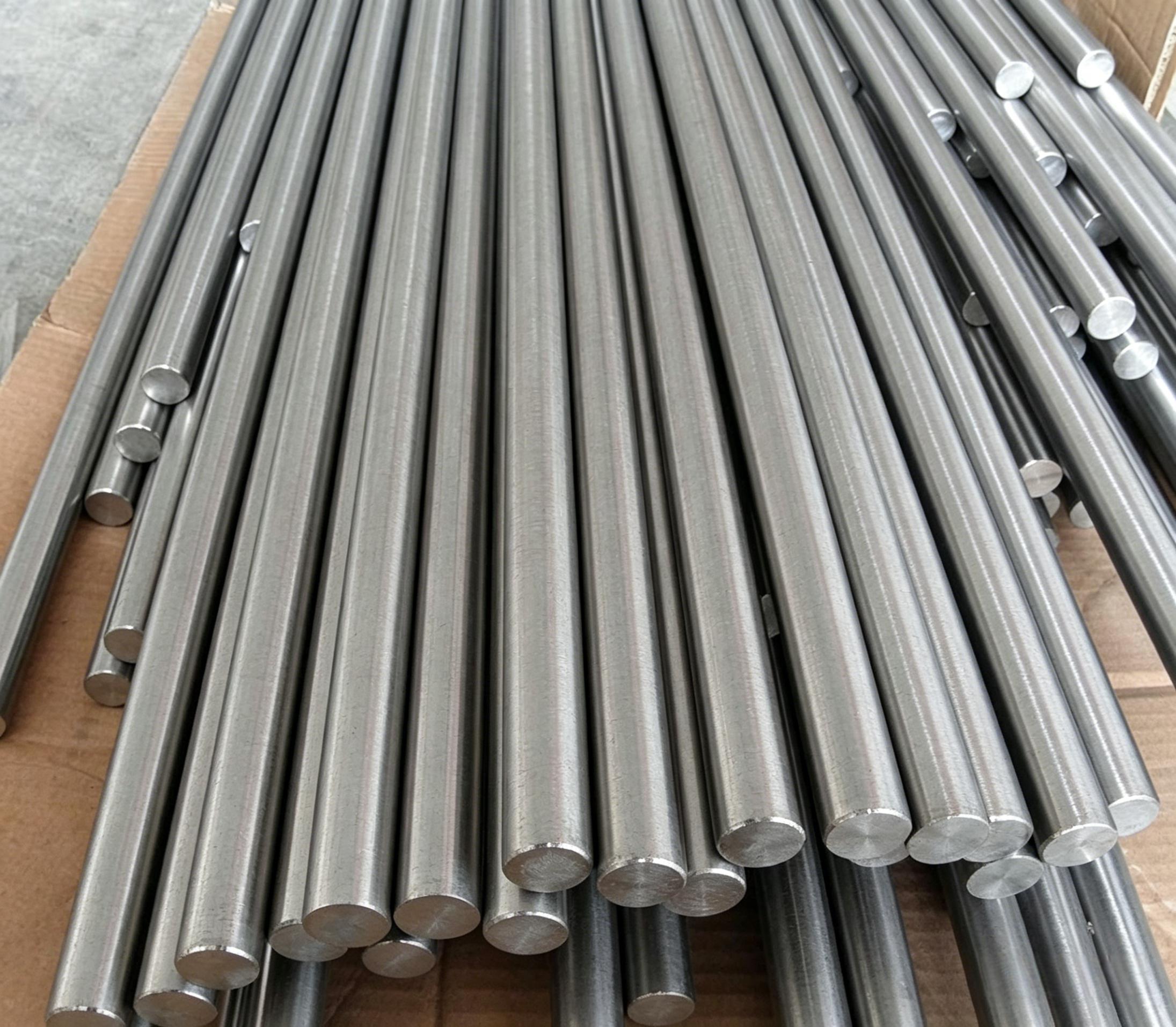
tight tolerance outer diameter, hard chrome ready surface
In piston rod machining, technical requirements are not optional guidelines — they are the direct determinants of product quality and service life. The rod’s dimensional accuracy governs sealing performance; its surface finish controls friction and wear; its coaxiality determines whether the cylinder operates smoothly or induces side loading that shortens both rod and seal life.
Below are the 7 core technical requirements that every precision CNC machining operation must master for reliable piston rod production.
1
Fit Tolerance: H8/h7 or H8/f7 with the Guide Sleeve
The mating fit between the piston rod and the guide sleeve (gland bushing) must be specified as H8/h7 (for a close sliding fit) or H8/f7 (for a free running fit with defined clearance). This fit governs the lateral stability of the rod within the cylinder bore, directly affects seal lip contact pressure, and determines whether the rod runs smoothly or with oscillating side loads. Incorrect fit selection — even by one tolerance grade — can cause premature seal failure or excessive guide sleeve wear within the first few thousand operating cycles.
2
Roundness and Cylindricity: Maximum Half of Diameter Tolerance
The roundness and cylindricity tolerances of the piston rod’s outer diameter must not exceed half the total diameter tolerance. For example, on a rod with a diameter tolerance of ±0.010mm (total 0.020mm), the roundness error must be held within 0.010mm. This requirement exists because any out-of-round condition creates a variable seal contact pattern through each revolution — one that causes the seal lip to alternate between over-compression and under-compression, generating heat, micro-abrasion, and accelerated fatigue cracking of the seal elastomer.
3
Outer Diameter Surface Finish: Ra 0.1–0.3 μm
The outer surface roughness of the piston rod should be maintained within the range of Ra 0.1–0.3 μm. This range is a carefully balanced specification. If the surface is too rough (Ra > 0.4 μm), the asperities act as micro-cutting edges against the seal lip, causing rapid seal wear. If the surface is too smooth (Ra < 0.05 μm), insufficient oil film retention leads to dry running conditions. The Ra 0.1–0.3 μm window supports a stable hydrodynamic oil film while minimising abrasive interaction with the seal. Achieving this consistently on long shafts requires superfinishing after precision grinding, not grinding alone.
4
Journal Coaxiality to Support Bearing Journal
The working journal diameter must be coaxial with the support bearing journal to within specified limits. Failure to maintain coaxiality introduces an eccentric rotating mass that generates vibration, increases bearing dynamic loads, and degrades transmission accuracy in precision hydraulic and servo systems. In practice, coaxiality is controlled by machining all critical diameters in a single setup wherever possible — or by using consistent datum (center hole) referencing when multiple setups are unavoidable.
5
Perpendicularity of Piston End Face to Rod Axis: ≤ 0.04mm/100mm
The perpendicularity tolerance between the piston’s axial end face and the piston rod centerline must not exceed 0.04mm per 100mm. Any deviation from this perpendicularity causes the piston to sit at a slight angle within the cylinder bore — a condition known as piston tilt. Tilt generates non-uniform contact pressure on the cylinder bore wall, localised chrome wear, and asymmetric loading on the rod seals. In severe cases it can cause the piston rod to bind (stick-slip) during the stroke, which is destructive to both the sealing system and the downstream mechanism being driven.
6
Surface Roughness Matched to Mating Component Type
Surface roughness specification is not uniform across all journal surfaces — it must be matched to the mating component:
Journals mating with transmission components (gears, couplings, cams): Ra 2.5–0.63 μm — sufficient for reliable power transmission with standard interference or transition fits.
Journals mating with rolling element bearings: Ra 0.63–0.16 μm — required to prevent fretting damage to the bearing inner race and to ensure correct bearing seating under press fit conditions.
Specifying the wrong surface finish for the mating type is a common source of premature failure in hydraulic assemblies — bearings seated on over-rough journals develop fretting corrosion within weeks of commissioning.
7
Piston Journal to Outer Diameter Coaxiality: ≤ 0.01mm
The coaxiality tolerance between the piston journal (where the piston seats onto the rod) and the rod’s outer diameter must not exceed 0.01mm. This is the tightest coaxiality requirement in piston rod manufacture, and for good reason: any eccentricity between these two surfaces means the piston will run off-center relative to the cylinder bore. The resulting eccentric motion causes the piston outer diameter to generate differential side loading against the bore wall, producing localised chrome wear on one side of the bore, uneven piston seal compression, and — in high-cycle applications — eventual hydraulic bypass that progressively reduces actuator force output.
Piston Rod Production Requirements: Process Discipline in Practice
Meeting the seven technical requirements above demands not only capable equipment, but disciplined process sequencing throughout the entire manufacturing workflow.
Surface Finish Target and No Straightening Policy
The finished piston rod surface roughness must achieve Ra 0.4–0.8 μm as a minimum production standard — the final value depending on the sealing and fitting specification. Critically, no manual straightening is permitted at any stage of the machining process. Mechanical straightening introduces unpredictable residual stress patterns into the rod that can cause delayed distortion after chrome plating or during service under alternating load. Straightness must be achieved and maintained through process control — correct fixturing, steady rest placement, and progressive stock removal — not corrective intervention.
Datum Consistency: Two-Center-Hole Referencing
To maintain coaxiality and positional accuracy across all machining operations, all turning and grinding operations must reference the same two center holes at both ends of the workpiece. This unified datum approach (analogous to the datum unification principle in GD&T) eliminates accumulated positional error that arises when different operations reference different surfaces. The center holes must be inspected and re-lapped as necessary between operations to ensure they are clean, undamaged, and provide a stable, repeatable seating surface for the lathe centers.
Separated Rough and Finish Turning — Follower Rest Throughout
Rough turning and finish turning must be performed as separate, distinct operations — never combined. Rough turning removes the majority of stock quickly, generating heat and cutting forces that cause workpiece deflection and residual stress. Completing the finish pass after the workpiece has stabilised (both dimensionally and thermally) produces a far more accurate and consistent result.
Follower rests (lunettes) must be used throughout both rough and finish turning operations to support the rod immediately adjacent to the cutting zone. Without a follower rest, the cutting force causes the long, slender workpiece to deflect away from the tool, producing a characteristic “barrel” diameter profile — larger in the middle than at the ends — that violates cylindricity requirements. When machining both-end threads, a center rest is additionally required to stabilise the rod at its midpoint and prevent thread form distortion during cutting.
Grinding: Center Hole Maintenance and Lubrication
During cylindrical grinding of the piston rod outer diameter, the workpiece is prone to elastic deflection and tool “spring” — phenomena that cause the ground diameter to be slightly larger than programmed, with progressive taper along the length. To counter this, the center holes must be lapped and cleaned before each grinding setup, and proper lubrication between the center holes and lathe centers must be confirmed. A contaminated or worn center hole transmits vibration into the workpiece during grinding rotation, producing chatter marks on the ground surface that cannot be corrected without additional passes and risk of dimensional overcut.
Thread Machining and Guide Sleeve Assembly Sequencing
Thread machining on piston rods presents a specific assembly challenge: if the thread tolerance class is broad (lower fit quality), the thread’s self-centering capability is insufficient to guarantee coaxial assembly of the guide sleeve. In this case, the guide sleeve must be located by its external sealing surface diameter, not by the thread.
However, if the external sealing surface engagement length is shorter than the thread engagement length, the assembly sequence must be managed carefully: the thread should enter engagement first to capture and pre-align the component, followed by engagement of the sealing surface — ensuring the final located position is determined by the precision sealing diameter and not by the thread form. This sequencing discipline prevents assembly-induced coaxiality errors that would otherwise only become apparent during seal leak testing or in-service inspection.
Summary
Precision CNC turning for stainless steel mixing shafts and piston rods demands a combination of correct material understanding, tightly controlled process sequencing, and consistent datum referencing from first cut to final inspection. The seven technical requirements for piston rods — covering fit tolerance, roundness, surface finish, coaxiality, perpendicularity, surface finish differentiation by mating type, and piston-to-rod coaxiality — are not independent specifications. They interact: a failure in one area (for example, insufficient cylindricity) compounds errors in another (seal performance), leading to failures that are expensive to diagnose and even more expensive to correct in the field.
For buyers qualifying CNC machining suppliers for these components, the ability of a supplier to articulate and document their process controls for each of these requirements — not just claim they can meet the drawing — is a meaningful indicator of manufacturing maturity and supply chain reliability.
Need precision CNC turned piston rods or stainless steel mixing shafts?
Precimach is an ISO 9001 certified CNC machining factory based in Suzhou, China, specialising in long-shaft and large-diameter turning, with steady rest support, multi-axis turning centers, and full CMM dimensional inspection. Tolerances to ±0.005mm. Fast quote within 12 hours.