
Client
US Stair Installation Contractor
Part Type
Tapered Solid Steel Baluster Shafts
Quantity
55 pieces — 3 variants (5040 series)
Delivery
DDP USA — completed 7 days early
Lead Time
20-day target (China to USA)
Key Challenge
Slender tapered shaft — vibration & chatter control
Tapered steel baluster CNC turning presents a unique set of machining challenges — and this project brought all of them together in a single urgent order. A US-based stair installation contractor needed 55 custom solid steel balusters in three variants of the 5040 profile, each approximately one metre in length with a continuous taper along the full shaft. Local US suppliers were unable to meet the specification, and the client needed the parts delivered DDP to the USA within 20 days of order placement — production time included.
Precimach accepted the project with a clear goal: not only to meet the deadline and quality requirement, but to deliver a result that would earn the client’s trust for the larger volume orders that would follow. This case study documents the technical challenges we encountered, the custom tooling solution we engineered, the in-process improvement we developed mid-production, and the outcome for the client.
Precimach specialises in precision CNC turning for slender shafts, tapered components, and custom low-volume production. View our CNC turning capabilities →
Project Overview: Custom Tapered Steel Baluster Shafts for US Stair Contractor
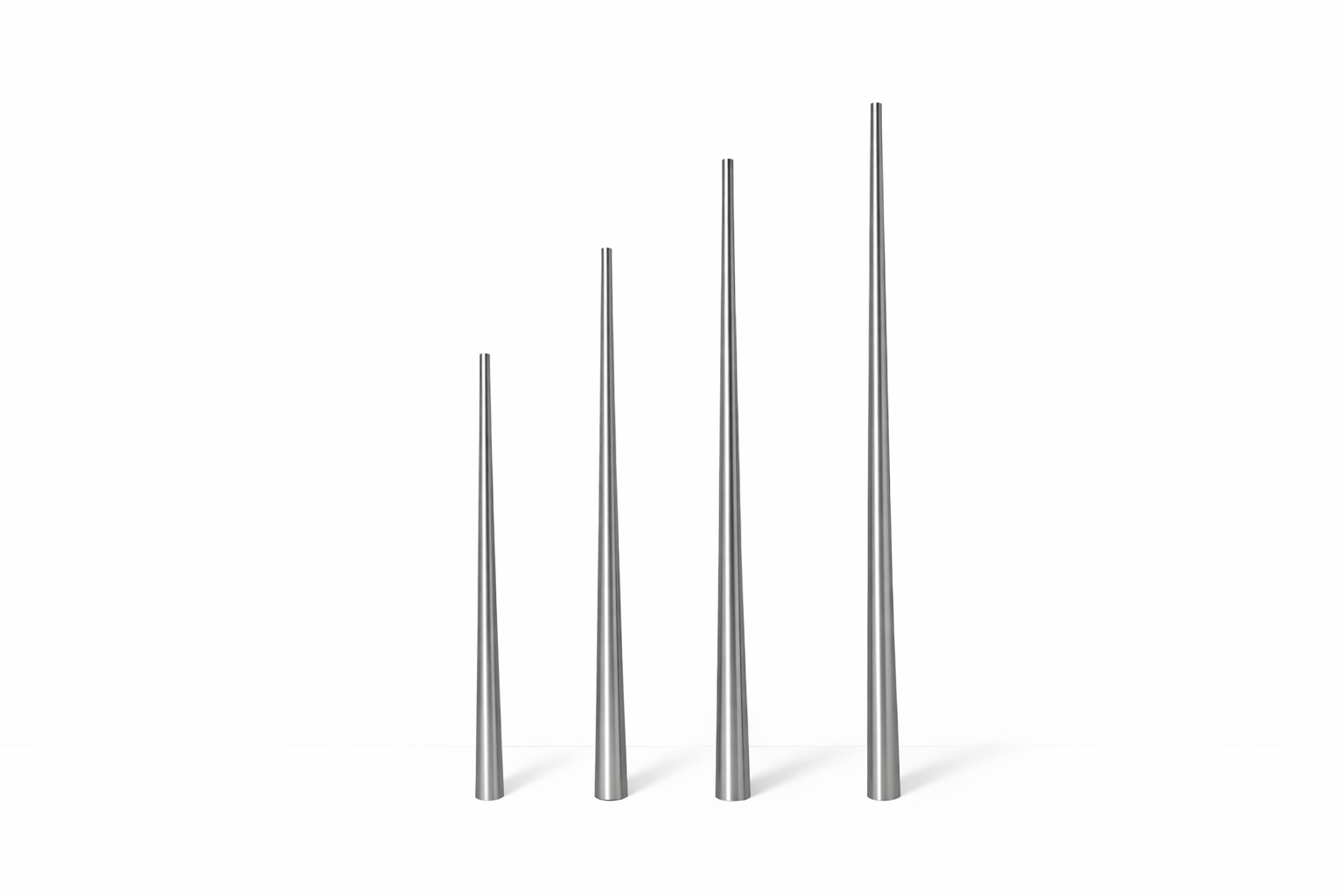
55 pieces across 3 variants, ~1,000mm length each
The client is a specialist stair installation contractor based in the United States, supplying custom baluster assemblies to residential and commercial construction projects. For this order, they required 55 solid steel balusters in the 5040 profile — a tapered, slender-shaft design approximately 1,000mm in length — across three dimensional variants.
The order was small by production standards but technically demanding. No local US supplier they approached had the turning capacity and shaft-machining experience to handle the combination of long length, continuous taper geometry, and tight surface finish requirement within the available timeline. The client turned to Precimach based on our reputation for precision shaft turning and fast international delivery.
The project requirements in summary: 55 tapered solid steel balusters, 3 profile variants, ~1,000mm length per piece, surface finish suitable for architectural visible application, DDP delivery to the USA, total lead time 20 days from order — including manufacturing, quality inspection, packaging, airfreight, and customs clearance.
Technical Challenges: Why Tapered Steel Baluster CNC Turning Is Difficult to Get Right
Tapered steel baluster CNC turning on shafts of this geometry involves a combination of challenges that standard turning operations do not encounter. Our engineering team identified four primary difficulties during the initial drawing review:
① Machine Travel Limitation
At approximately 1,000mm in length, these balusters exceed the working stroke of standard CNC turning centres. Conventional lathes with insufficient Z-axis travel cannot complete the full taper in a single clamping — requiring a mid-process repositioning that introduces coaxiality error and surface discontinuity at the transition point.
② Chatter and Vibration (Slender Shaft Effect)
Long, slender shafts with high L/D ratios (length-to-diameter) deflect under cutting force during turning. This deflection causes the tool to follow a wavy path rather than the programmed taper profile, resulting in chatter marks and tool vibration that produce a visibly rough surface — unacceptable for an architectural finish application.
③ Surface Finish on Visible Components
These balusters are architectural elements — they will be visibly installed and subject to close visual inspection. Tool marks, chatter lines, or surface irregularities that would be acceptable on an industrial shaft are not acceptable here. Without vibration control, the turned surface would require significant post-processing (grinding and polishing) to remove tool marks — adding time and cost.
④ 20-Day DDP Deadline Including Logistics
The 20-day window covered not just machining but also prototyping, quality inspection, packaging, international airfreight, and US customs clearance. Any process inefficiency — including the need for post-machining grinding to correct surface finish — would directly risk the delivery deadline.
Root cause summary: The core challenge was not material hardness or dimensional complexity — it was eliminating vibration-induced chatter on a long tapered slender shaft to achieve a clean surface finish in a single turning pass, without grinding, within a compressed timeline.
Why Precimach Was Positioned to Solve This
Precimach operates a dedicated shaft machining workshop — a specialist facility configured specifically for the turning of long, slender, and large-diameter rotational components. This is not a general-purpose CNC shop that occasionally handles shaft work: shaft turning is our core competency, and our equipment and process knowledge reflect more than a decade of continuous investment and refinement in this specific capability.
Precimach shaft turning capability at a glance:
Turning Length Range
0.02 m — 16 m
Diameter Range
10 mm — 1,600 mm
Years of Experience
10+ years shaft turning
Clients Served
2,000+ globally
Custom Capability
Non-standard profiles supported
Equipment
World-class CNC turning centres
Our shaft workshop is equipped with advanced large-format CNC turning centres capable of handling workpieces well beyond one metre in length in a single setup. Crucially, our engineering team has deep experience with the specific challenges of slender shaft turning — including steady rest selection, workpiece support strategy, toolpath optimisation, and custom fixturing — that are required to achieve clean surface finishes on long tapered shafts without post-machining grinding.
Our Solution: Custom Tooling, Prototype Validation, and Continuous Improvement
Phase 1 — Engineering Review and Custom Tooling Design
After a thorough review of the client’s drawings, our engineering team confirmed the key challenge: a standard fixed steady rest would not provide adequate support for a continuously tapered shaft of this slenderness ratio. The changing diameter along the taper means a fixed steady rest would either over-constrain the workpiece at the thick end or lose contact entirely at the thin end — neither of which provides the vibration damping needed for a clean finish.
Our solution was to design and fabricate custom tooling for this specific geometry — a hydraulic follower rest with telescopic adjustment capability. Unlike a fixed steady rest, a hydraulic follower rest travels with the cutting tool along the Z-axis, providing continuous lateral support immediately behind the cutting zone. The hydraulic actuation maintains consistent contact force against the workpiece regardless of the changing diameter along the taper — eliminating the vibration that would otherwise generate chatter marks.
▶ Prototype turning process — from raw material to finished baluster:
This video documents the full prototype sequence: material setup, hydraulic follower rest positioning, tapered turning in two segments, and final surface inspection. You can see the follower rest travelling with the cutting tool and providing continuous lateral support against the tapered workpiece.
The prototype confirmed the tooling concept worked — chatter was significantly reduced and the taper profile was accurate across the full length. A surface polishing step was included at this stage to achieve the final architectural finish requirement.
Gen-1 hydraulic follower rest — prototype turning sequence,
two-segment pass + polishing finish
Phase 2 — Prototype Validation
The custom hydraulic follower rest was fabricated and fitted, and a prototype run was completed before committing to full production. The prototype confirmed our engineering assessment: with this tooling, tapered steel baluster CNC turning achieved a dramatically cleaner surface — chatter was significantly reduced, taper profile accuracy was maintained across the full length, and the process cycle time was within budget. However, to fully meet the architectural surface quality requirement, a final surface polishing step was still needed at this stage to remove the remaining light tool marks. The taper profile was accurate and the process cycle time remained within the delivery schedule.
With prototype validation complete and the process plan confirmed — turn first, polish second — we immediately scheduled full production, running all 55 pieces according to this validated sequence while simultaneously working to eliminate the polishing step entirely.
Phase 3 — Mid-Production Process Innovation
While the production batch ran on schedule using the turn-then-polish process, our engineering team identified two remaining limitations in the first-generation approach. First, the hydraulic follower rest required the turning operation to be split into two segments: the tool would travel to the mid-point, the machine would pause, the rest position would be manually reset, and cutting would resume from the new reference point. This mid-cycle repositioning added non-cutting time and introduced a small dimensional discontinuity risk at the transition zone. Second, even with the first-generation follower rest, the tapered turning still left light residual tool marks on the surface — requiring a post-machining polishing step that added both time and cost per piece.
For Precimach, a process that requires two setups when one should suffice — and a polishing step that exists only to correct a machining limitation — is a process that needs to be improved. While the production batch continued on schedule, our engineering team developed a second-generation solution: a CNC-integrated hydraulic follower rest with automatic position adjustment linked directly to the machine’s numerical control system. As the cutting tool traverses the Z-axis, the CNC program automatically commands the follower rest to adjust its lateral contact position in real time — maintaining optimal, consistent support pressure against the changing taper profile throughout the complete turning pass, without any mid-cycle pause or operator adjustment.
The result: tapered steel baluster CNC turning completed in a single continuous pass, with surface finish quality clean enough to eliminate the polishing step entirely — reducing cycle time, removing process variation, and delivering a better surface directly from the turning operation.
Gen-2 CNC-integrated follower rest — single-pass full-length
taper turning, no mid-cycle pause, no polishing required
▶ Second-generation CNC-integrated follower rest — the breakthrough:
This video shows the second-generation CNC-integrated hydraulic follower rest in operation. The key difference is immediately visible: the turning tool travels the full length of the tapered shaft in a single uninterrupted pass — the CNC system automatically adjusts the follower rest position in real time as the diameter changes along the taper.
The result: no mid-cycle repositioning, no residual chatter marks, and no polishing step required. The surface finish quality is achieved directly from the turning operation — a genuine process improvement that reduces both cycle time and cost per piece for all future tapered shaft orders.
The second-generation follower rest delivered measurable improvements on all three metrics that matter for slender tapered shaft production:
↑ Surface Quality
The CNC-integrated follower rest eliminates residual tool marks directly from the turning pass — no post-machining polishing required. The surface finish quality is achieved in a single operation.
↓ Cycle Time
Removing mid-cycle repositioning and eliminating the polishing step reduces total process time per piece — significantly improving throughput for future volume production runs.
↑ Precision
Single-pass full-length turning eliminates the coaxiality risk at the mid-point transition. Automatic CNC rest adjustment produces identical dimensional and surface quality on every piece.
Process engineering note: The CNC-integrated hydraulic follower rest developed for this project is now part of Precimach’s standard tooling inventory for tapered slender shaft turning — available for all future orders requiring this geometry. The R&D investment made on this small-volume project directly improves our competitive capability on every subsequent tapered shaft order, regardless of volume.
Results: Delivered One Week Early — and a Platform for Future Growth
55
pieces delivered across 3 variants, 100% conforming to drawing
7 days
ahead of the 20-day DDP deadline
0
pieces rejected or requiring rework — zero quality escapes
2×
tooling generations developed — process capability permanently upgraded
Production was completed ahead of the original schedule. Throughout the manufacturing process, we provided the client with real-time updates — sharing progress photos and video clips, and forwarding airfreight tracking information as soon as the shipment was dispatched. The client received their parts with a full week to spare before their own installation deadline.
The client acknowledged Precimach’s rapid response, transparent communication, and willingness to take on a technically challenging low-volume order that other suppliers had declined. They indicated that future volume orders for this baluster profile — and potentially for other shaft components in their product range — would be directed to Precimach.
We are candid about the economics of this project: a 55-piece low-volume custom order with custom tooling development and express airfreight does not generate a margin comparable to a volume production run. The investment in the second-generation CNC-integrated follower rest alone represented a significant cost relative to the order value. But at Precimach, our approach to low-volume projects is deliberately long-term. We treat each new technical challenge as an opportunity to build process capability that will differentiate us on every subsequent order — and each new client relationship as the foundation of a long-term partnership.
“Precimach responded faster than anyone we’d approached domestically, kept us informed throughout the process, and delivered a week ahead of schedule. The surface finish on the balusters was exactly what we needed for visible installation. We’ll be coming back for the production run.”
— US Stair Installation Contractor, Project Client
Technical Note: Slender Shaft Turning and the Steady Rest Selection Problem
For engineers and procurement professionals sourcing tapered steel baluster CNC turning or similar slender shaft components, the following technical context is relevant for evaluating supplier capability.
The standard approach to long slender shaft turning uses a steady rest (lunette) — a fixed support device that contacts the workpiece at a fixed axial position and prevents lateral deflection. Steady rests work well for cylindrical shafts, where the contact diameter is constant. For tapered shafts, a fixed steady rest cannot follow the changing profile — creating the vibration and chatter problems described in this case study.
A follower rest is a more advanced solution that travels with the cutting tool, providing support immediately behind the cutting zone. For cylindrical shafts, standard follower rests are widely available. For tapered shafts, the follower rest must compensate for the changing diameter as it travels — which is why our first-generation hydraulic solution required mid-process adjustment, and why the CNC-integrated second-generation design represents a genuine technical advance for this geometry.
For further technical background on slender shaft machining and workpiece support strategies in precision turning operations, the ASME B5.57 standard (Methods for Performance Evaluation of CNC Turning Centers) provides the internationally recognised framework for turning centre capability assessment — including workholding, dynamic stiffness, and surface finish achievement — used by precision manufacturers globally.
Industry reference: ASME B5.57 — Methods for Performance Evaluation of CNC Turning Centers is the standard used to characterise the precision capability of CNC lathes, including dynamic stiffness tests relevant to slender shaft and tapered component turning performance.
Have a Similar Shaft Machining Challenge?
If you are sourcing custom slender shafts, tapered turning components, or low-volume precision shaft production — and your domestic suppliers cannot meet the specification, the lead time, or both — Precimach can help. We have the equipment, the process experience, and the custom tooling capability to handle geometries that standard CNC shops decline.
Ready to discuss your custom shaft project?
Precimach is an ISO 9001 certified CNC machining factory in Suzhou, China — specialising in precision shaft turning, tapered and slender shaft machining, long-shaft and large-diameter turning. We serve clients in the USA, Europe, and across Asia with DDP logistics, full CMM inspection, and 24-hour English support.
- Shaft turning: 0.02 m to 16 m length, 10 mm to 1,600 mm diameter
- Custom tooling and fixturing for non-standard geometries
- Low-volume custom orders accepted — no minimum order quantity
- DDP shipping to USA — 3–5 days airfreight after production
- Real-time production updates and full inspection reports
- ISO 9001 certified — material certifications provided