
Client
European Aerospace UAV Manufacturer
Application
UAV Rudder Control System
Output Torque
12 N·m
Backlash
≤ 2.5 arcmin achieved
Delivery
2 weeks — 33% faster than target
Contract Won
3-year · 5,000 units
UAV planetary gearbox CNC machining for aerospace applications sits at the intersection of the most demanding requirements in precision manufacturing: extreme temperature tolerance, minimum backlash, maximum torque density, and compact geometry — all in a component that must perform with zero failure across thousands of flight hours. When a leading European aerospace UAV manufacturer needed a reliable long-term supplier for the planetary gearboxes powering their rudder control system, Precimach was selected to develop the prototype and secure the production contract.
This case study documents the engineering challenges, material and process decisions, validation testing, and production results — including how we delivered 20 fully functional custom prototypes in 2 weeks, 33% faster than the client’s target, and secured a 3-year production agreement for 5,000 units.
Precimach provides precision CNC machining for aerospace, robotics, and defense drivetrain components. View our CNC machining capabilities →
Project Overview: UAV Planetary Gearbox CNC Machining for Rudder Control System
The client is a leading European aerospace UAV manufacturer developing high-altitude unmanned aerial vehicles for defence and surveillance applications. Their rudder control system uses a compact planetary gearbox to step down the output of a high-speed brushless motor to the torque and speed required to actuate the rudder surface with precision and authority.
The operating environment presented exceptional material and manufacturing challenges: the gearbox must operate reliably from −45 °C at altitude to +120 °C under thermal load, survive 10g random vibration during flight, and maintain backlash ≤ 3 arcmin throughout its service life of ≥ 10,000 hours — all within a housing diameter of only 38 mm.
The client was seeking a single qualified supplier capable of custom engineering, rapid prototype delivery, and volume production — and required 20 customised prototype units within 3 weeks before committing to a production agreement. This tight prototype timeline, combined with the technical complexity of the specification, was the primary supplier qualification challenge.
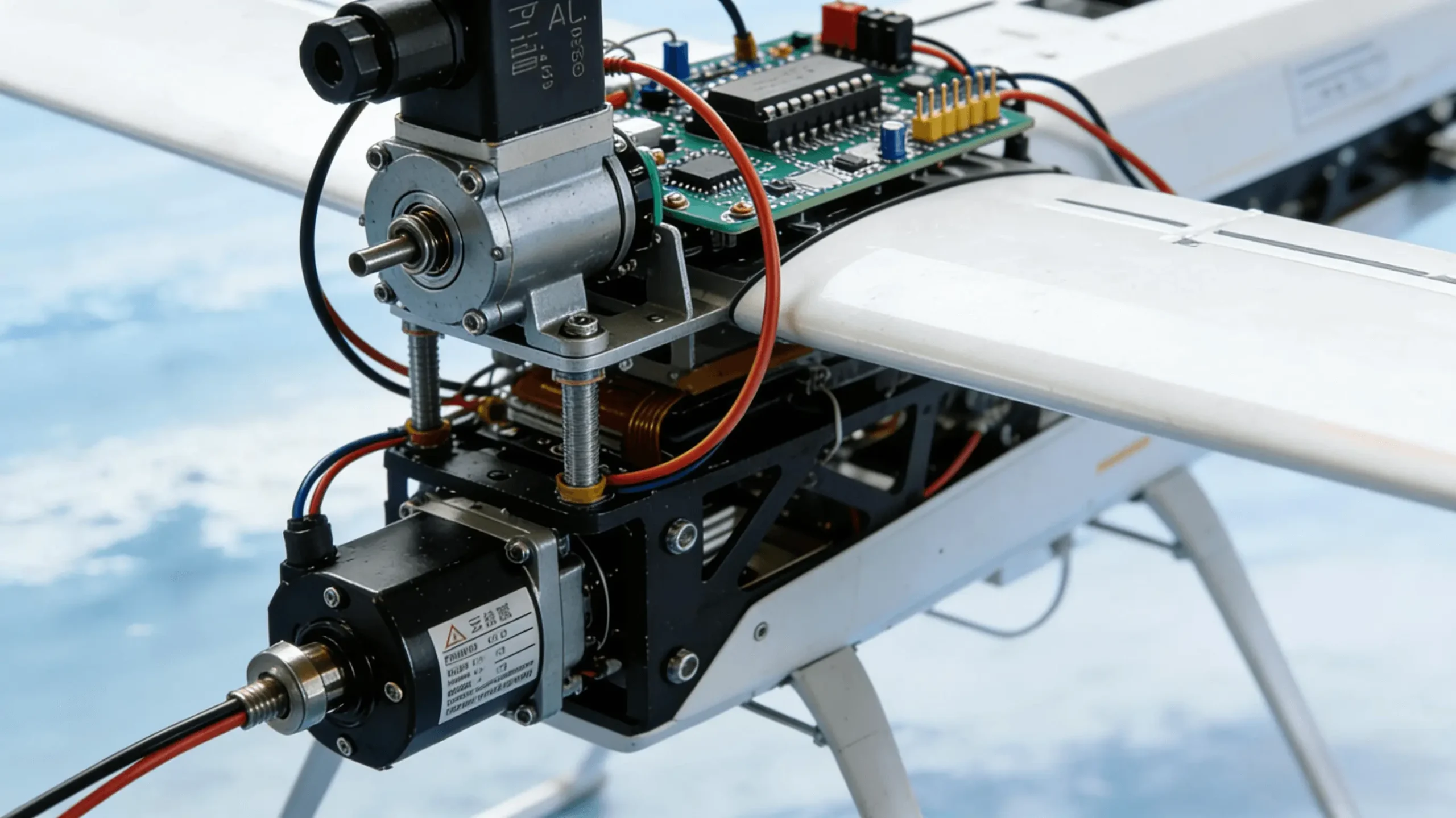
38mm diameter, precision CNC machined for aerospace rudder control
Technical specification summary:
| Parameter | Requirement | Achieved |
|---|---|---|
| Gearbox Diameter | 38 mm max | 38 mm ✓ |
| Output Torque | 12 N·m | 12 N·m verified ✓ |
| Backlash | ≤ 3 arcmin | ≤ 2.5 arcmin ✓ |
| Operating Temperature | −45 °C to +120 °C | 1,000 cycles passed ✓ |
| Service Life | ≥ 10,000 hours | Qualified ✓ |
| Prototype Delivery | 3 weeks (20 units) | 2 weeks — 33% early ✓ |
Core Engineering Challenges
① Extreme Environmental Range
A 165 °C operating temperature span (−45 °C to +120 °C) drives severe differential thermal expansion across dissimilar materials. Gear mesh clearances, bearing preloads, and housing fits — all optimised at assembly temperature — must remain within tolerance across the full operating range. Material selection and tolerance stack-up analysis must account for this expansion differential at every interface.
② High Torque in Minimum Diameter
Achieving 12 N·m output torque in a 38 mm diameter envelope requires gear geometry, tooth profile, and material hardness to be optimised simultaneously. There is no margin for conservative material choices or standard gear quality grades — every element must perform at the limit of its capability.
③ Backlash ≤ 3 arcmin
3 arcmin backlash in a 38 mm gearbox requires gear grinding and honing to micron-level tooth profile accuracy, precision-matched planet gears, and controlled bearing preload. Standard hobbing tolerances are insufficient — the full gear train must be precision ground and selectively assembled to achieve this specification.
④ 20 Prototypes in 3 Weeks
20 fully assembled, tested, and validated gearbox prototypes in 3 weeks — while simultaneously completing all engineering design, toolpath programming, fixturing, and first-article inspection — requires parallel workflow management and a supplier with dedicated capacity commitment to the project.
Our Engineering Solution: Materials, Precision Machining, and Validated Assembly
Material and Component Engineering
Material selection for this application had to simultaneously address corrosion resistance, thermal stability across a 165 °C span, fatigue strength under cyclic torque loading, and machinability for the tight tolerance features required. Three different material specifications were selected for the three primary component groups:
Gearbox Housing — AISI 4340 High-Strength Alloy Steel
AISI 4340 provides the high yield strength (up to 1,470 MPa when heat treated) and toughness required to contain 12 N·m output torque in a 38 mm housing wall without deformation. Its low coefficient of thermal expansion minimises housing bore growth at high temperature, preserving bearing fit and gear mesh geometry across the operating range.
Gears and Shafts — 17-4PH Stainless Steel, HRC 40–45
17-4PH precipitation-hardening stainless steel combines corrosion resistance with high hardness (HRC 40–45 after H900 heat treatment) and excellent fatigue properties. For gear tooth surfaces operating in high-altitude moisture environments under cyclic contact stress, 17-4PH delivers the wear resistance of a hardened steel without the corrosion vulnerability of carbon tool steels.
Sealing System — Custom IP65-Rated Structure
A custom IP65-rated sealing arrangement was designed to exclude moisture and particulate contamination at altitude while maintaining shaft rotational freedom across the full temperature range. Seal material selection (fluorosilicone elastomers) was validated for compression set performance at both −45 °C and +120 °C extremes.
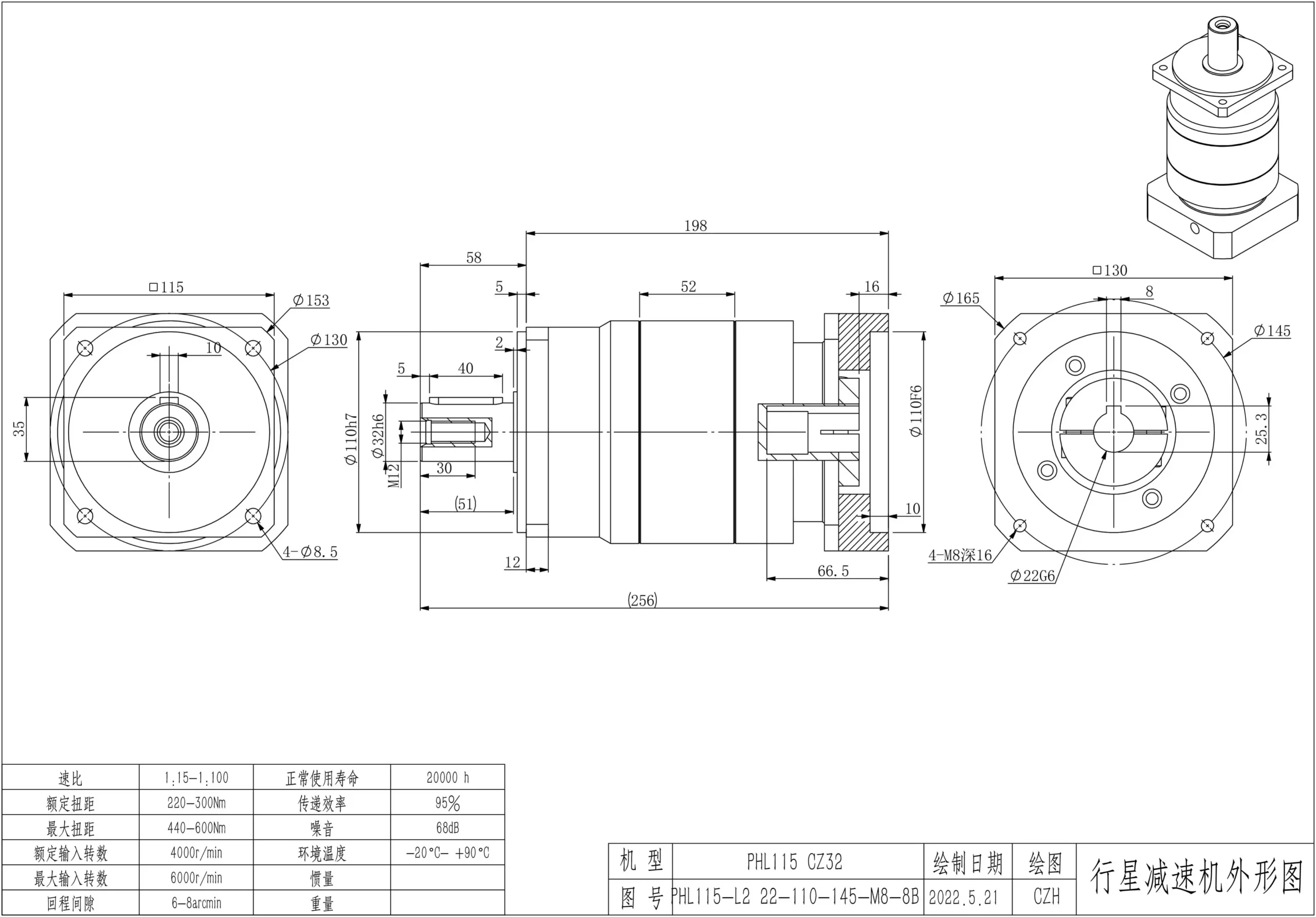
precision gear geometry, tight backlash specification
CNC Machining and Precision Manufacturing
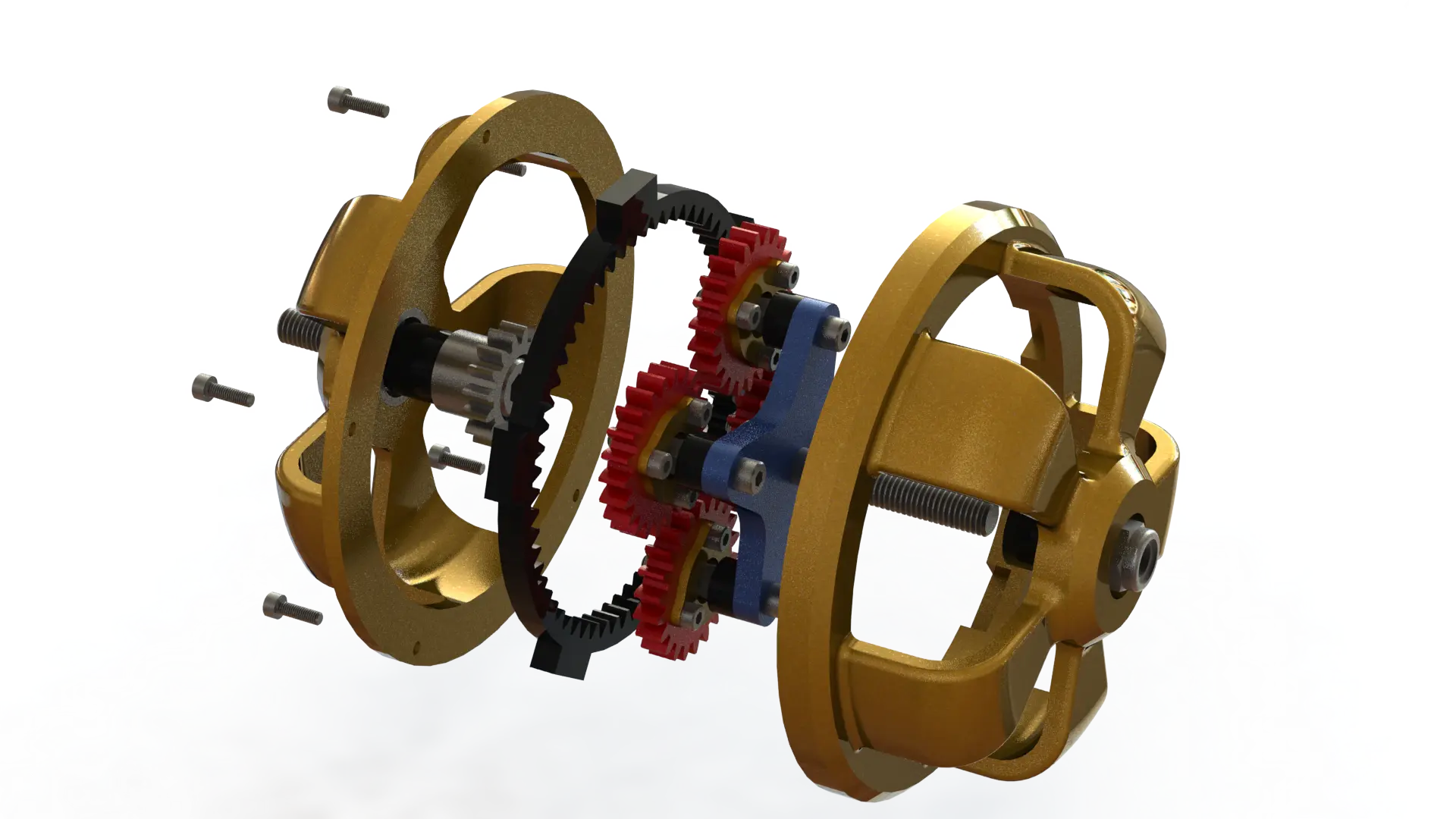
all components precision CNC machined and gear ground
5-Axis CNC Milling — Ra 0.8 μm Surface Finish
5-axis simultaneous machining of the gearbox housing, planet carrier, and bearing bores achieved Ra 0.8 μm surface finish on all critical mating surfaces in single setups — eliminating re-clamping error and ensuring concentricity of all bores to the central axis within micron-level tolerance.
Gear Grinding and Honing — Backlash Control
All sun gears, planet gears, and ring gears were precision ground and honed to AGMA Class 11 tooth profile accuracy. Planet gears were selectively matched in sets to minimise accumulated backlash. The honing process refined tooth surface finish to reduce noise and improve load distribution uniformity at the gear mesh interface.
Cleanroom Assembly — Class 10,000
Final assembly of all 20 prototype gearboxes was performed in a Class 10,000 (ISO Class 7) cleanroom environment to prevent particulate contamination of the precision gear mesh and bearing interfaces. Bearing preload was applied and verified per the assembly specification before sealing and final torque/backlash testing.
Testing, Validation, and Results
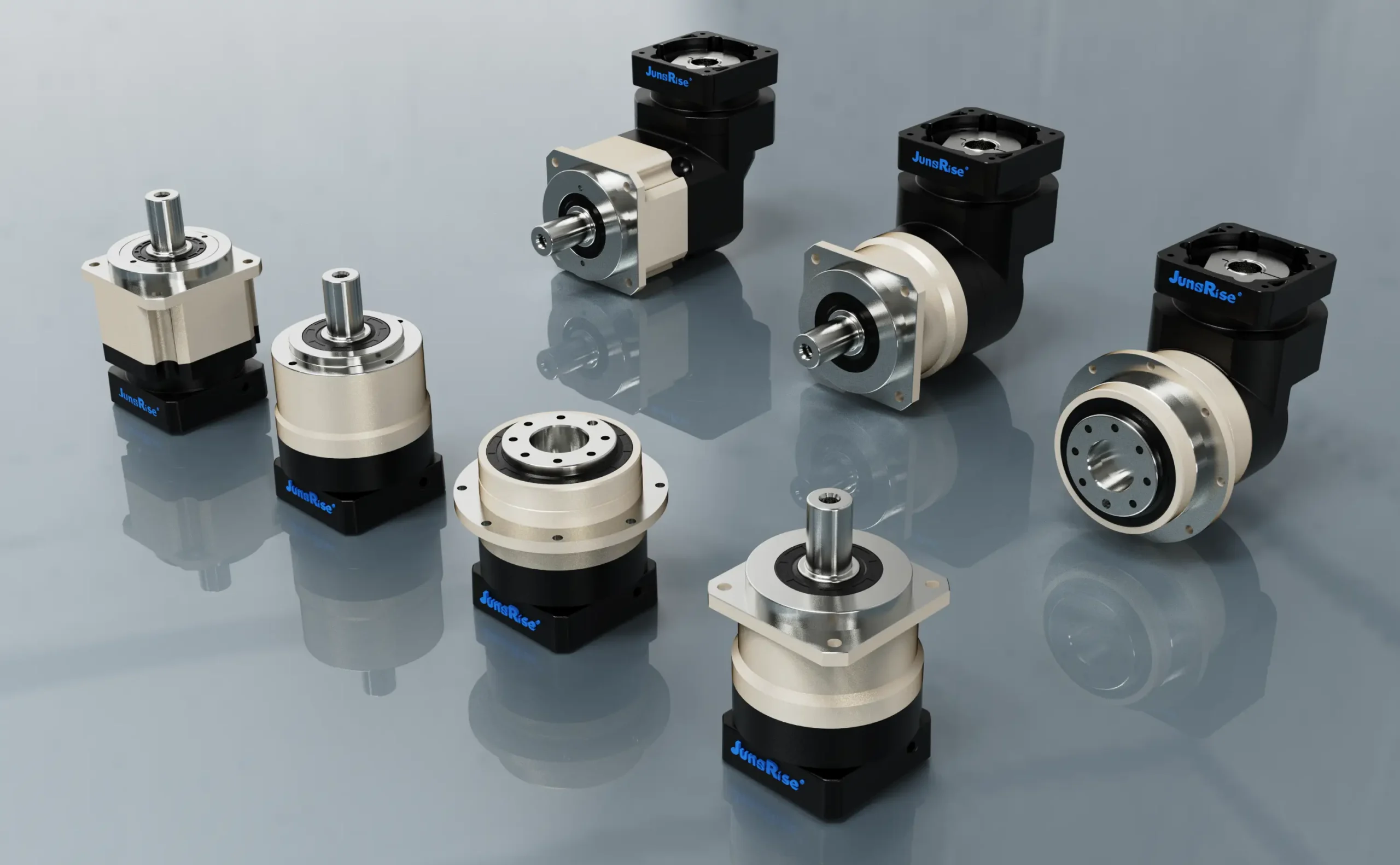
38mm, 12 N·m, cleanroom assembled and validated
Validation Testing Protocol
→
Thermal cycling: 1,000 cycles from −45 °C to +120 °C — simulating full service life thermal fatigue. Backlash and torque capacity re-verified after cycling.
→
Torque and backlash verification: Output torque confirmed at 12 N·m; backlash measured at ≤ 2.5 arcmin on all 20 units — exceeding the ≤ 3 arcmin specification.
→
Random vibration testing: 10g random vibration across the UAV flight frequency spectrum — simulating worst-case airframe vibration loads. Zero structural or functional failures recorded.
100%
functional performance in 50+ flight tests
2 weeks
prototype delivery — 33% faster than target
28%
reduction in supply-chain costs vs previous supplier
3-year
sole-supplier production contract · 5,000 units
“The precision and reliability of the planetary gearboxes exceeded our expectations. The ability to deliver fully customized prototypes in just two weeks was critical to our flight-testing schedule. We now consider Precimach our sole supplier for this critical UAV component.”
— Chief Engineer, European Aerospace UAV Manufacturer
Planetary Gearbox Technology: Working Principles and Aerospace Applications
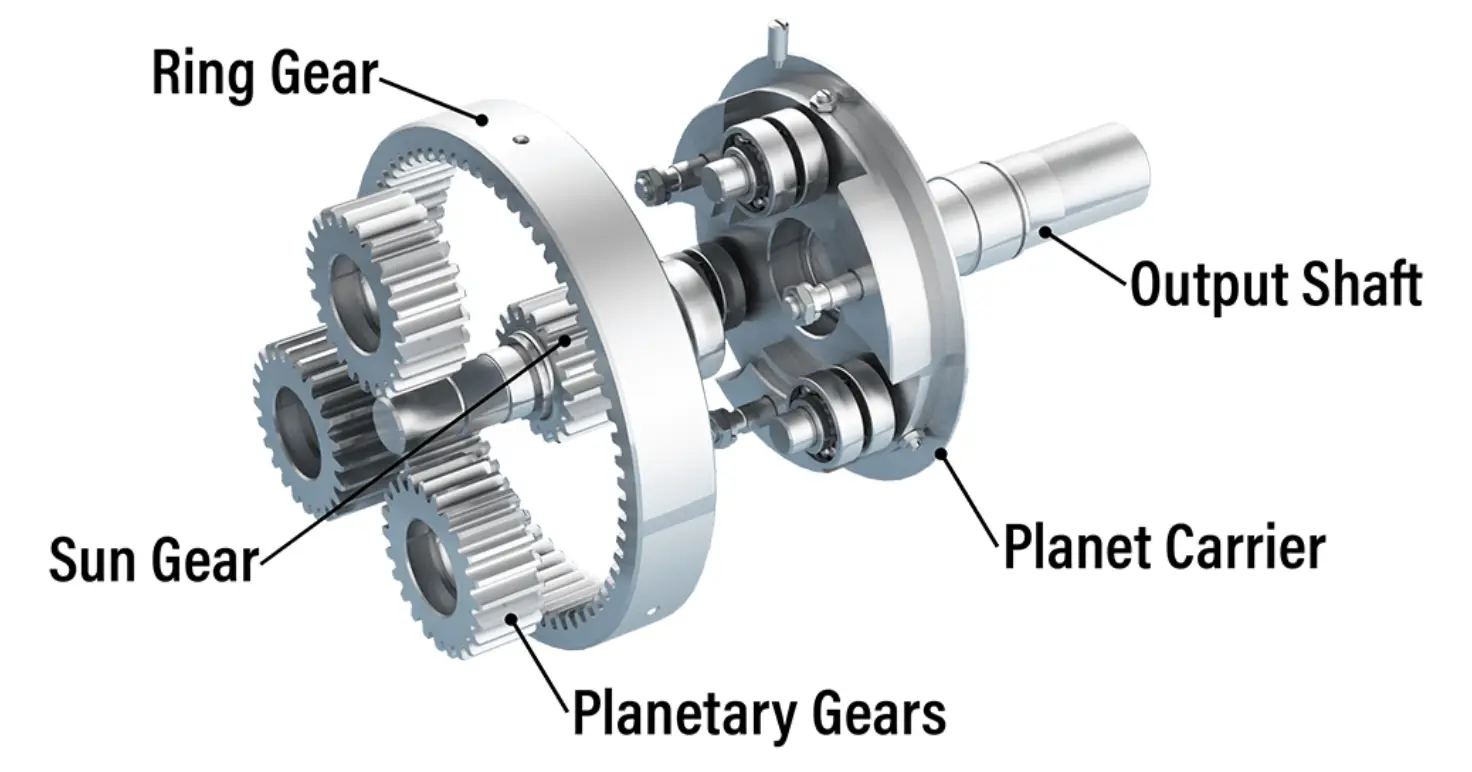
sun gear, planet gears, ring gear, and planet carrier
How a Planetary Gearbox Works
A planetary gearbox — also called an epicyclic gearbox — consists of four primary elements: a sun gear at the centre, two to four planet gears that orbit around it, a ring gear (annulus) that surrounds the planet gears, and a planet carrier that holds the planet gears in their orbital positions and transmits output torque.
When the sun gear rotates (driven by the motor), the planet gears rotate on their own axes while simultaneously revolving around the sun gear inside the ring gear. The planet carrier — attached to the output shaft — rotates at a speed determined by the gear ratio between sun and ring gears. Because the load is shared simultaneously across multiple planet gears, the torque capacity per unit of gearbox size is far higher than in a conventional parallel-shaft gear arrangement.
This load-sharing architecture is what makes planetary gearboxes the first choice for high-torque, compact, weight-critical applications — which is exactly the requirement profile of UAV drivetrain and control surface actuator systems.
Why Planetary Gearboxes Are Used in UAV Rudder Control
Maximum torque density
Multiple planet gears share the load simultaneously — producing 2–5× higher torque output per gram of gearbox weight compared to spur or helical gear arrangements of equivalent diameter.
Coaxial input/output
Input and output shafts are on the same axis — enabling compact integration with brushless motors in tight UAV fuselage packaging without offset drive arrangements.
Minimum backlash
Precision-ground planetary gearboxes achieve backlash as low as 1–3 arcmin — essential for rudder control systems where position error directly translates to flight path deviation.
High stiffness and shock tolerance
The symmetric load distribution across planet gears produces high torsional stiffness and excellent resistance to shock and vibration loads — critical for UAV flight in turbulent conditions.
Technical Note: Qualifying a Supplier for UAV Planetary Gearbox CNC Machining
For aerospace engineers and procurement professionals sourcing UAV planetary gearbox CNC machining, the supplier qualification questions that most reliably predict production success go beyond machine specifications. The capability to deliver this class of component requires a specific combination of gear grinding experience, thermal analysis capability, cleanroom assembly, and validated testing — none of which can be inferred from CNC machine inventory alone.
- Can you achieve AGMA Class 11 or better on gears this small? Sub-40mm gears at AGMA Class 11 require dedicated gear grinding equipment and process experience — not all precision CNC shops have this capability.
- How do you address differential thermal expansion in mixed-material assemblies? The answer should reference specific tolerance stack-up analysis at temperature extremes — not just material selection.
- What is your cleanroom classification for final assembly? For aerospace gearboxes, Class 10,000 (ISO 7) is the minimum acceptable environment to prevent particulate contamination of precision gear interfaces.
- What validation testing have you performed on similar components? A supplier with documented thermal cycling, vibration, and functional test records from previous aerospace gearbox programmes is substantially lower risk than one relying on drawing compliance alone.
For further technical reference on precision gear quality grades and inspection standards applicable to aerospace planetary gearbox components, the AGMA 2015-1-A01 standard (Accuracy Classification System — Tangential Measurements for Cylindrical Gears) is the internationally recognised specification for gear tooth accuracy classification — defining the tolerance grades (AGMA Class 3–12) used by aerospace OEMs and precision gearbox manufacturers globally to specify and verify gear quality for high-performance applications.
Industry reference: ANSI/AGMA 2015-1-A01 — Accuracy Classification System for Cylindrical Gears defines the AGMA gear accuracy classification system (Classes 3–12) covering tooth profile, helix, pitch, and runout tolerances — the standard referenced by aerospace UAV and precision gearbox manufacturers when specifying and verifying gear quality in drivetrain and control surface actuator applications.
Need Precision CNC Machined Gearbox or Drivetrain Components?
If you are sourcing precision planetary gearboxes, drivetrain components, or aerospace structural parts that require tight backlash, extreme temperature performance, and validated assembly — Precimach has the engineering capability, gear grinding equipment, and cleanroom assembly facility to support your programme from prototype to production.
Ready to discuss your precision drivetrain project?
Precimach is an ISO 9001 certified CNC machining factory in Suzhou, China — specialising in precision CNC machining for aerospace, robotics, defence, and high-performance industrial applications. We provide complete manufacturing solutions from engineering review through prototype delivery, validation testing, and volume production.
- 5-axis CNC milling for complex gearbox housings and carriers
- Gear grinding and honing — AGMA Class 11 and above
- Materials: AISI 4340, 17-4PH, titanium, PEEK, aluminium alloys
- Class 10,000 cleanroom final assembly
- Thermal cycling, vibration, torque, and backlash validation testing
- Rapid prototyping — 20 units in 2 weeks demonstrated
- ISO 9001 certified — full inspection documentation per batch